
For bathtub importers, product design affects more than appearance and comfort.
It also determines how many units can fit into a container, how much warehouse space is required, and how efficiently the products can be handled throughout the supply chain.
A stackable bathtub is designed so that multiple units can be placed safely inside or above one another with suitable protection between them. For high-volume import programs, this structure can significantly improve container utilization and reduce logistics costs per unit.
Based on Salvere’s experience in acrylic bathtub manufacturing, this article explains why stackable design should be considered during product selection and development—not after the bathtub has already entered production.
Buyers can also explore different structures in the Salvere acrylic bathtub collection.
Quick Answer
Stackable bathtub design matters because it can help importers:
- Load more units into one container
- Reduce freight cost per bathtub
- Use warehouse space more efficiently
- Simplify internal handling
- Reduce excessive packaging volume
- Improve the commercial viability of high-volume products
However, stackability must be engineered carefully.
The bathtub shape, rim, exterior angle, internal space, reinforcement, and protective materials must work together to prevent scratches, pressure damage, deformation, and instability during transportation.
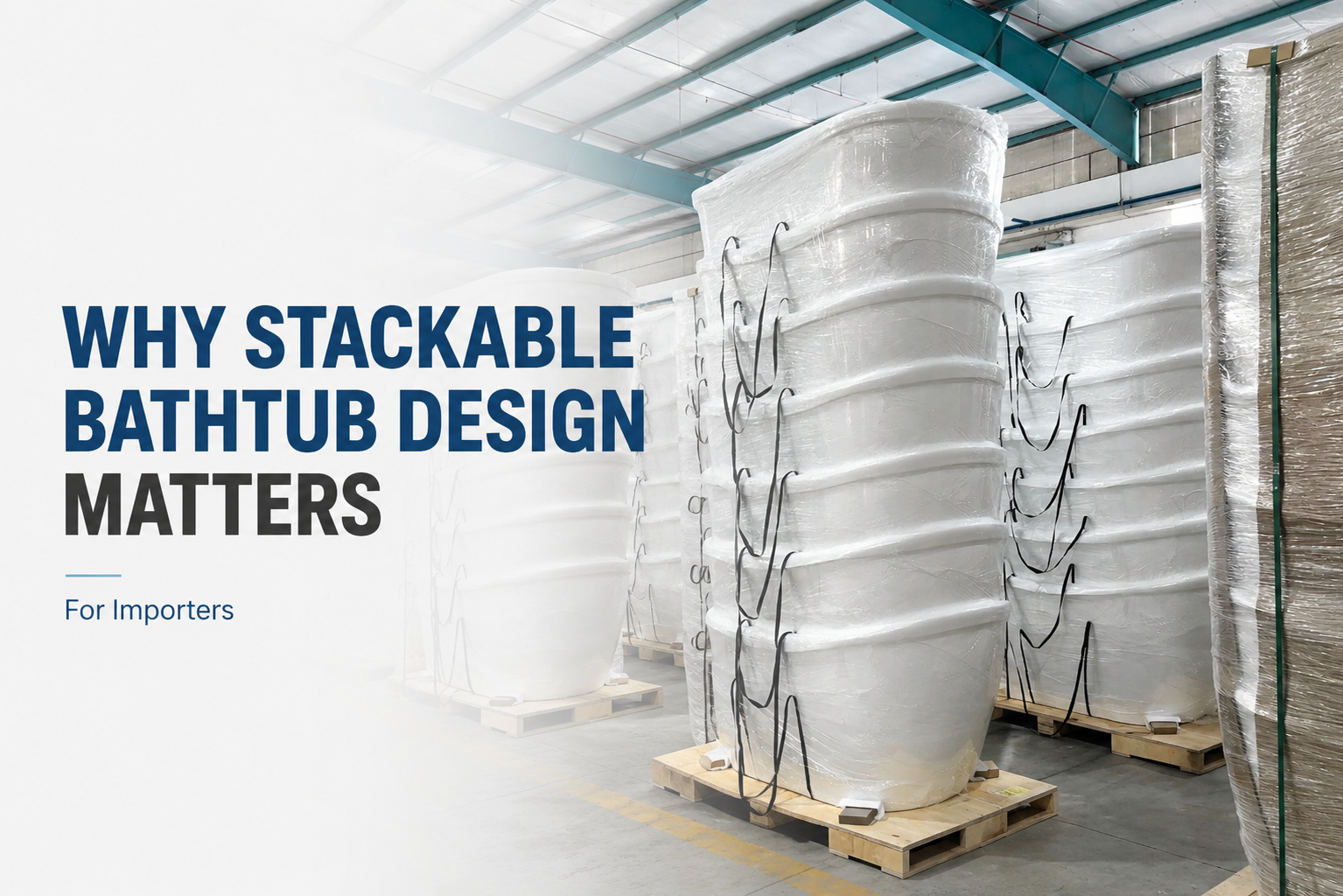
What Is a Stackable Bathtub?
A stackable bathtub is designed so that multiple bathtub shells or finished products can be positioned together vertically or nested partially inside one another.
Depending on the product structure, stackability may apply to:
- Formed acrylic shells during production
- Alcove bathtub bodies
- Skirted bathtubs
- Selected freestanding bathtub structures
- Inner and outer shells before assembly
- Finished products with specially designed protection
Stackable does not simply mean placing one bathtub on top of another.
A properly designed system must control:
- Contact points
- Load distribution
- Clearance between products
- Surface protection
- Maximum stacking quantity
- Product stability
- Safe removal after transportation
Stackable vs. Non-Stackable Bathtub Design
| Comparison | Stackable Design | Non-Stackable Design |
|---|---|---|
| Container utilization | Usually higher | Usually lower |
| Freight cost per unit | Potentially lower | Often higher |
| Warehouse space | More efficient | Requires more floor space |
| Product shape | Must support nesting or stable stacking | Greater freedom in exterior shape |
| Packaging requirements | Requires controlled separators and protection | Often packed individually |
| Handling | Efficient when procedures are defined | Simpler individual handling |
| Main risk | Pressure or surface damage between units | Higher packaging and logistics cost |
Better Container Utilization
Bathtubs are large-volume products.
In many cases, shipping cost is determined more by the space the product occupies than by its weight.
A non-stackable freestanding bathtub may require an individual carton that occupies almost the full external volume of the product. This can limit the number of units loaded into a container.
A stackable design allows unused internal space to be reduced by nesting products together.
This may help importers:
- Load more bathtubs per container
- Reduce the number of containers required
- Lower freight cost per unit
- Improve the landed cost of the product
- Make lower-priced bathtub programs more commercially practical
The actual loading quantity depends on the bathtub dimensions, stacking depth, packaging structure, and container type.
Importers should therefore request a proposed loading plan before approving a model.
More Efficient Warehouse Storage
Container efficiency is only one benefit.
Stackable bathtubs may also require less warehouse space before distribution.
This is especially valuable for:
- High-volume distributors
- Regional warehouses
- Project suppliers
- Retail fulfillment centers
- Importers carrying multiple bathtub models
Products that cannot be stacked safely may occupy a large amount of floor space, increasing storage costs and limiting inventory flexibility.
However, the supplier should clearly define:
- Maximum stacking height
- Required separators
- Safe storage duration
- Lifting and removal procedures
- Whether finished products can remain stacked after arrival
Product Shape Determines Stackability
Not every bathtub can be made stackable.
The exterior and interior shapes must allow one unit to fit partially inside another without creating damaging contact.
Important design factors include:
- Side-wall angle
- Rim width
- Rim overhang
- Bathtub depth
- Exterior curves
- Bottom dimensions
- Drain projection
- Overflow fittings
- Outer-shell structure
- Decorative details
Bathtubs with straight or slightly tapered walls are generally easier to nest than products with wide bases, complex exterior curves, or large projecting rims.
A highly sculptural shape may create stronger visual differentiation, but it may also reduce container-loading efficiency.
For importers, the best product is not always the design with the smallest carton or the most dramatic appearance. It is the product that balances market appeal, structural performance, and total logistics cost.
Rim and Edge Design Require Special Attention
The rim is one of the most sensitive areas during stacking.
If the upper bathtub transfers too much pressure onto the rim below it, the product may experience:
- Scratches
- Cracks
- Edge deformation
- Gloss differences
- Pressure marks
- Misalignment between the inner and outer shells
Thin-edge bathtubs require especially careful protection because their visual value depends on a clean and precise rim profile.
The stacking system may therefore need:
- Foam separators
- Molded protective blocks
- Rim guards
- Controlled contact areas
- Maximum stacking limits
Stackability should never be achieved by allowing finished acrylic surfaces to contact one another directly.
Reinforcement Must Support the Stacking Method
A bathtub designed for stacking still needs to remain structurally stable.
The factory should evaluate how stacking pressure interacts with:
- Fiberglass reinforcement
- Support boards
- Steel frames
- Adjustable feet
- Inner- and outer-shell connections
- Drain and overflow areas
In some cases, the structural frame or installed fittings may prevent finished products from nesting deeply.
The supplier may need to adjust the assembly sequence so that certain components are installed after the main bathtub bodies are separated.
This is why stackable design should be reviewed during product development rather than treated only as a packaging decision.
Salvere can evaluate product structure, reinforcement, and logistics together through our OEM/ODM acrylic bathtub solutions.
Packaging Still Matters
Stackable products do not eliminate the need for packaging.
They require a different packaging strategy.
A stackable bathtub shipment may use:
- Protective film on visible surfaces
- Foam between every unit
- Rim and corner guards
- Bottom supports
- External wrapping
- Reinforced base pallets
- Straps with pressure protection
- Clearly defined stacking quantities
The packaging should prevent movement during:
- Factory handling
- Container loading
- Ocean transportation
- Container unloading
- Warehouse storage
Before approving the packaging, buyers should request:
- Packing photos
- Stacking diagrams
- Container-loading plans
- Units-per-container calculations
- Packaging-material specifications
- Trial-loading results
Stackability Can Influence Product-Line Planning
Importers should not evaluate each bathtub model independently.
A product line may include:
- Premium non-stackable models for higher-margin retail
- Stackable models for wholesale volume
- Compact products for apartment projects
- Standardized products for builders and contractors
This creates a more balanced collection.
For example, a sculptural freestanding bathtub may strengthen the brand image, while a stackable skirted or alcove model supports better volume and logistics efficiency.
The role of each model should be clear before it is added to the product range.
What Importers Should Confirm
Before selecting a stackable bathtub, ask the supplier:
- How many units can be stacked safely?
- How deeply do the products nest?
- Which surfaces carry the stacking pressure?
- What protective materials are placed between units?
- How many units fit into a container?
- Are the calculations based on an actual trial loading?
- Can the products remain stacked in the warehouse?
- Are drains, frames, or fittings installed before or after stacking?
- How are products removed without scratching?
- Has the packaging been tested under transportation conditions?
Container-loading claims should be supported by measurements and a practical loading plan.
How Salvere Supports Stackable Bathtub Projects
Salvere manufactures acrylic bathtubs in Ho Chi Minh City, Vietnam, for bathroom brands, importers, distributors, and project buyers.
For suitable product structures, our team can evaluate:
- Bathtub nesting depth
- Rim and edge protection
- Inner- and outer-shell geometry
- Reinforcement requirements
- Assembly sequence
- Packaging materials
- Container-loading quantity
- Warehouse handling
- Mass-production consistency
Stackability is reviewed together with product appearance, structural stability, and production feasibility.
Buyers developing a new product can also read our guide on how a custom acrylic bathtub moves from sketch to mass production.
Frequently Asked Questions
Are all alcove bathtubs stackable?
No.
Many alcove tubs have structures that support efficient stacking, but the rim, skirt, flange, reinforcement, and installed components still need to be evaluated.
Can freestanding bathtubs be stackable?
Some freestanding bathtub structures can be nested or partially stacked, especially before final assembly.
Highly sculptural or fully assembled products may be more difficult to stack safely.
Does stackable design reduce product quality?
Not when it is engineered correctly.
The design must maintain sufficient reinforcement, surface protection, and structural stability. Logistics efficiency should not be achieved by weakening the bathtub.
Is the highest container quantity always the best option?
No.
Excessive stacking may increase the risk of pressure damage, scratches, deformation, or difficult unloading.
The best loading plan balances quantity with product protection.
Final Thoughts
For importers, stackable bathtub design is not simply a packaging advantage.
It can influence:
- Freight cost
- Container utilization
- Warehouse efficiency
- Product pricing
- Inventory planning
- Transportation risk
A well-developed stackable bathtub should balance three requirements:
Marketable design → reliable structure → efficient logistics
Salvere helps global buyers evaluate stackability as part of complete acrylic bathtub product development and supply-chain planning.


