
Drain position may look like a small technical detail, but it can influence the bathtub’s internal shape, user comfort, plumbing layout, installation direction, and product compatibility with different bathroom projects.
For bathroom brands, importers, distributors, and project buyers, selecting the wrong drain configuration can create installation problems even when the bathtub’s overall dimensions appear suitable.
Based on Salvere’s experience in acrylic bathtub manufacturing and OEM development, this guide explains the main drain-position options and what buyers should confirm before approving a product.
Quick Answer
Common bathtub drain positions include:
- Center drain
- Off-center or offset drain
- End drain
- Left-hand drain
- Right-hand drain
A center drain supports a more symmetrical bathtub design, while an end drain keeps the drain away from the main bathing area.
For alcove and skirted bathtubs, left- or right-hand drainage must match the plumbing layout and installation direction.
Before placing an order, buyers should confirm the exact drain location through technical drawings rather than relying only on product photos or general descriptions.
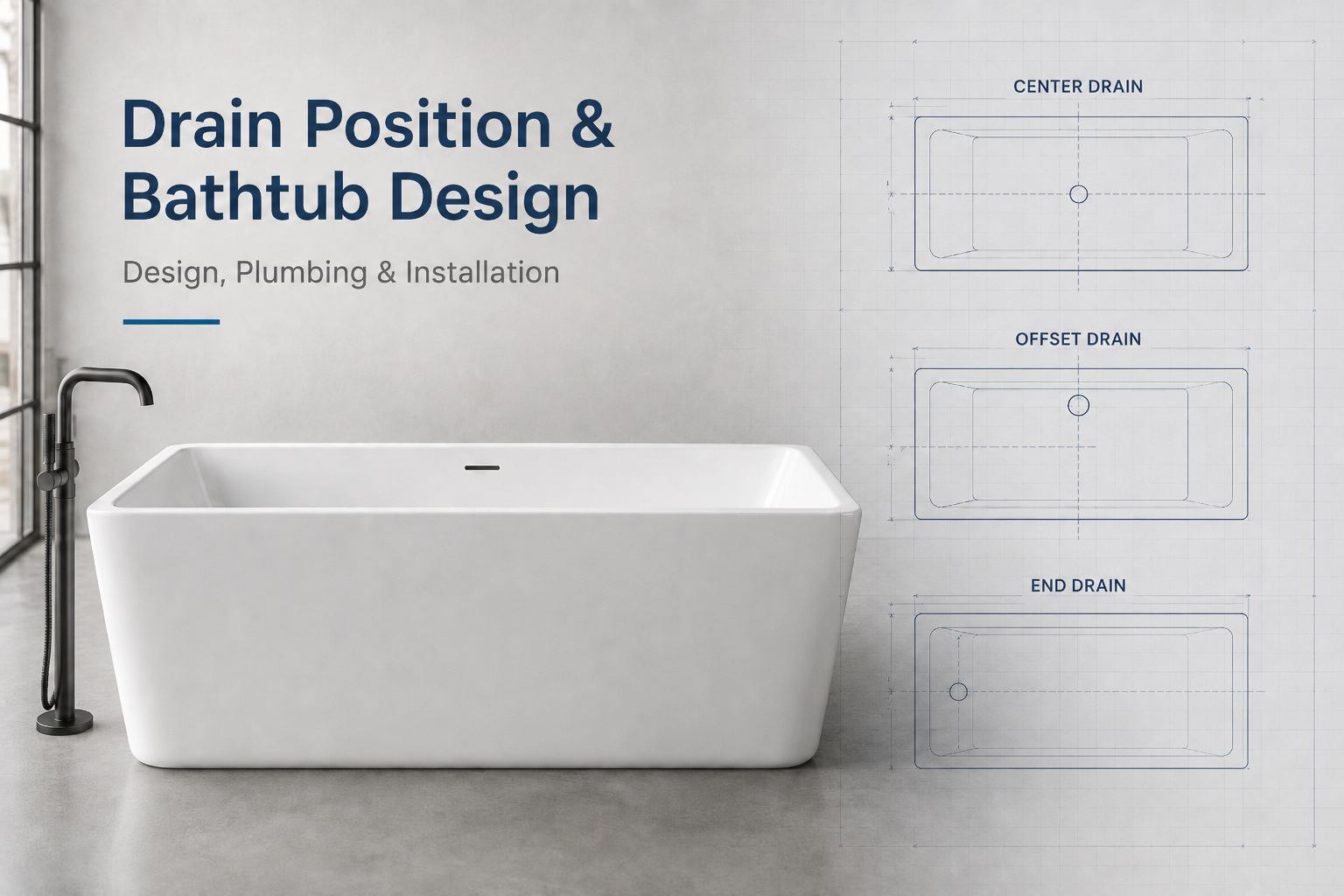
Common Bathtub Drain Positions
| Drain Position | Typical Product Type | Main Consideration |
|---|---|---|
| Center drain | Freestanding and double-ended tubs | Symmetrical design and flexible bathing direction |
| Off-center drain | Freestanding and soaking tubs | Maintains visual balance while improving comfort |
| End drain | Single-ended and back-to-wall tubs | Keeps the drain away from the main seating area |
| Left-hand drain | Alcove and skirted tubs | Must match the project’s left-side plumbing |
| Right-hand drain | Alcove and skirted tubs | Must match the project’s right-side plumbing |
Center Drain
A center drain is positioned near the middle of the bathtub floor.
It is commonly used in:
- Symmetrical freestanding bathtubs
- Double-ended bathtubs
- Two-person soaking tubs
- Bathtubs with matching backrests on both sides
Because the drain is centered, the bathtub can maintain a balanced internal and external appearance.
However, the drain may sit closer to the user’s body while bathing. The manufacturer must therefore consider the drain cover, floor contour, and available sitting space.
Center-drain designs also require the bathroom plumbing to align with the central area beneath the bathtub.
Off-Center or Offset Drain
An off-center drain is positioned away from the exact center but does not sit completely at the end of the bathtub.
This configuration may also be described as:
- Offset drain
- Off-center drain
- Drain positioned toward one end
- Drain located closer to the plumbing side
It is often used when the designer wants to maintain a relatively balanced appearance while keeping the drain away from the main seating area.
For example, a freestanding bathtub may have a drain positioned slightly closer to one side rather than directly in the center.
The exact location should always be shown in the technical drawing because the term “off-center drain” does not define a standard distance.
End Drain
An end drain is positioned near one end of the bathtub.
It is commonly used in:
- Single-ended bathtubs
- Alcove bathtubs
- Skirted bathtubs
- Back-to-wall bathtubs
- Bathtubs with one main backrest
This arrangement keeps the drain away from the main bathing or seating area.
The bathtub’s interior shape is usually designed around this direction. One end may have a more supportive backrest, while the drain and overflow are located at the opposite end.
For product listings, buyers should confirm whether the drain end is fixed or whether left- and right-hand versions are available.
Left-Hand and Right-Hand Drains
Left- and right-hand drainage is especially important for alcove and skirted bathtubs.
These products are normally installed in a fixed direction, so the drain must match the existing plumbing.
The drain orientation is usually identified while standing in front of the bathtub and facing it:
- Left-hand drain: the drain is on the left
- Right-hand drain: the drain is on the right
However, terminology can vary between markets and suppliers.
The safest approach is to confirm the drain location using:
- A dimensioned technical drawing
- A top-view diagram
- Product model identification
- Packaging labels
- Installation instructions
Buyers can review different installation structures through the Salvere acrylic bathtub collection.
How Drain Position Affects Bathtub Design
Drain location can influence more than the plumbing connection.
Interior Bathing Space
The drain and overflow occupy part of the bathtub’s internal structure.
Their position may affect:
- Seating area
- Foot space
- Backrest direction
- Interior symmetry
- Water depth
Bottom Contour
The bathtub floor must guide water toward the drain.
Changing the drain position may require adjustments to the internal slope and bottom shape.
Reinforcement Structure
The drain area normally requires additional structural attention.
The manufacturer must coordinate the drain opening with:
- Fiberglass reinforcement
- Support boards
- Steel frames
- Adjustable feet
- Plumbing access
External Appearance
Drain position can also affect the placement of the overflow opening and other visible details.
For symmetrical freestanding products, these elements should be coordinated carefully to maintain a clean appearance.
How Drain Position Affects Installation
Incorrect drain placement may require plumbing changes at the jobsite.
Buyers should confirm:
- Distance from the drain center to each product edge
- Drain-pipe diameter
- Vertical clearance below the bathtub
- Connection type
- Access for installation and maintenance
- Relationship between the drain and support frame
- Left- or right-hand orientation
- Finished floor location
For replacement and renovation projects, compatibility with existing plumbing is especially important.
A bathtub with the correct overall dimensions may still be unsuitable if the drain is positioned differently from the original product.
Can Drain Position Be Customized?
In some OEM and ODM projects, drain position can be customized.
However, moving the drain may affect:
- The thermoformed shell
- Bottom slope
- Overflow position
- Reinforcement
- Support-board layout
- Steel-frame structure
- Certification
- Tooling requirements
A small adjustment to the drilled opening may be possible on some products, while a major position change may require a new inner-shell mold.
The factory should evaluate the complete structure before confirming the modification.
Salvere’s OEM/ODM acrylic bathtub solutions support technical evaluation of product dimensions, drain positions, internal structures, surface finishes, branding, and packaging.
What Buyers Should Confirm Before Ordering
Before approving a bathtub model, request:
- Top-view technical drawing
- Exact drain-center measurements
- Overflow position
- Left- or right-hand orientation
- Drain-fitting specification
- Required floor clearance
- Support-frame layout
- Installation instructions
- Certification coverage
- Approved model and packaging labels
These details should be confirmed before sample approval and repeated on final production documents.
Common Drain-Position Mistakes
Common problems include:
- Using product photos to judge drain position
- Confusing left-hand and right-hand orientation
- Assuming an off-center drain follows a standard measurement
- Moving the drain without reviewing the bottom slope
- Ignoring the relationship between the drain and steel frame
- Approving a product before checking existing project plumbing
- Using different technical drawings for production and installation
Clear drawings and consistent model identification can prevent most of these problems.
How Salvere Supports Drain-Position Planning
Salvere manufactures freestanding, alcove, corner, two-sided, and skirted acrylic bathtubs in Ho Chi Minh City, Vietnam.
For OEM and wholesale projects, our team can help buyers evaluate:
- Center, offset, and end-drain layouts
- Left- and right-hand drain options
- Drain and overflow dimensions
- Internal bathing-space requirements
- Bottom-slope feasibility
- Reinforcement and frame coordination
- Installation compatibility
- Custom mold requirements
Drain position is reviewed together with the complete bathtub structure rather than treated as an isolated drilled hole.
Buyers can learn more about the full development process in our guide on how a custom acrylic bathtub is developed.
Frequently Asked Questions
Is an off-center drain the same as an end drain?
Not always.
An off-center drain is positioned away from the exact center, while an end drain is located closer to one end of the bathtub. The technical drawing should provide the exact measurement.
Which drain position is best for a freestanding bathtub?
There is no single best option.
Center drains work well for symmetrical and double-ended designs, while offset or end drains may provide a clearer seating area.
Can the drain position be changed without a new mold?
It depends on the bathtub structure and the amount of movement required.
Minor drilling adjustments may be possible on some models, while major changes to the bottom contour normally require mold modification.
Why are left- and right-hand drains important for alcove tubs?
Alcove bathtubs have a fixed installation direction. The drain orientation must match the plumbing and surrounding walls at the project site.
Final Thoughts
Drain position affects the bathtub’s design, comfort, structure, plumbing compatibility, and installation direction.
For buyers, the most important rule is simple:
Never confirm drain position from appearance alone. Confirm it through an approved, dimensioned technical drawing.
Salvere helps global bathroom brands, importers, and distributors evaluate drain configurations as part of complete acrylic bathtub product development.


