
A custom acrylic bathtub does not move directly from a sketch into mass production.
Between the initial idea and the finished product, the manufacturer must evaluate whether the bathtub can be thermoformed, reinforced, assembled, packaged, and reproduced consistently at scale.
For bathroom brands, importers, and product development teams, understanding this process helps reduce unnecessary revisions, control development costs, and prevent problems from appearing after the mold has already been completed.
Based on Salvere’s experience supporting OEM and ODM bathtub projects, this guide explains the main stages of custom acrylic bathtub development.
Buyers who are still deciding whether a new mold is necessary can first read our guide on existing molds versus custom bathtub molds.
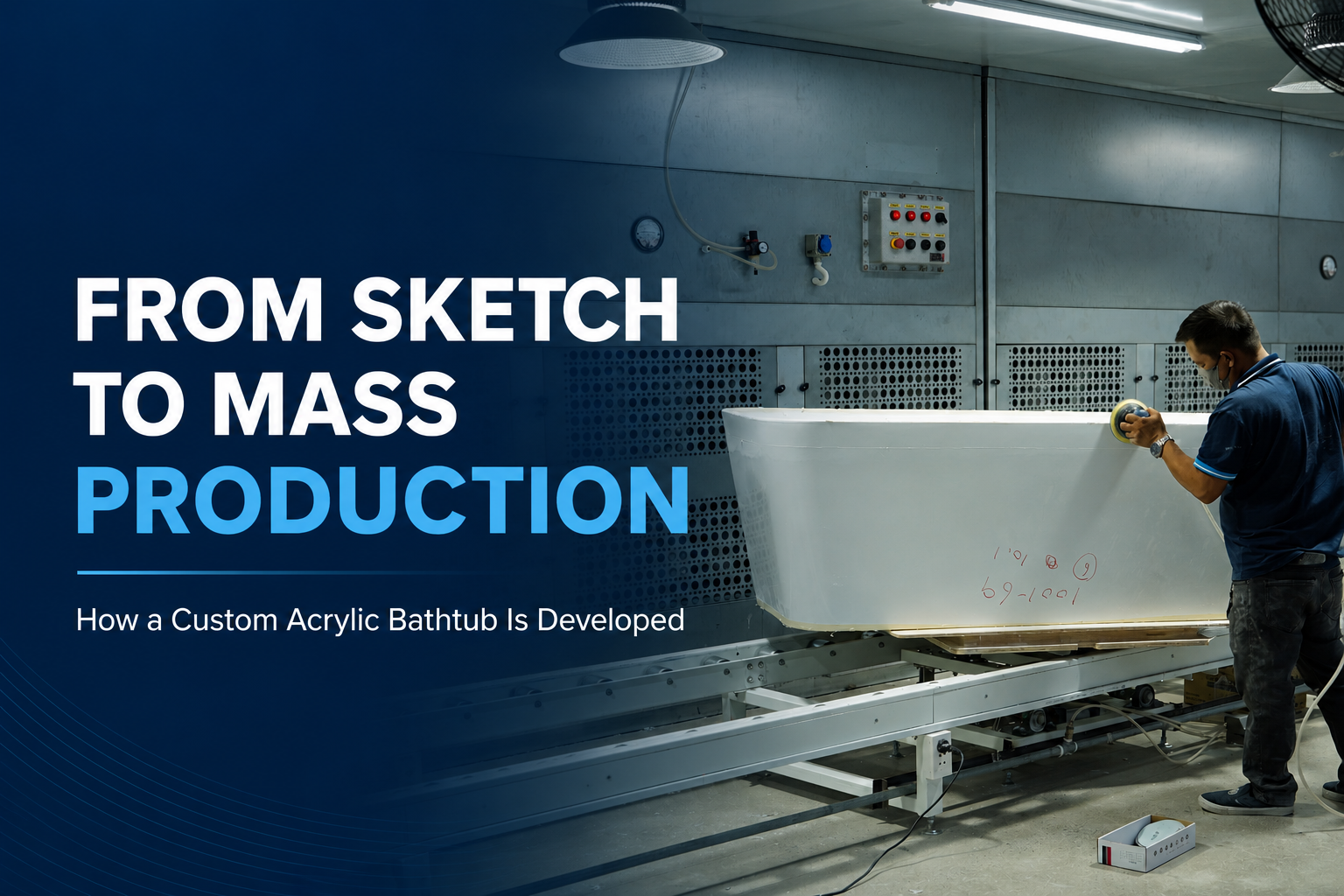
Quick Answer
A custom acrylic bathtub normally moves through the following stages:
- Product requirements and market positioning
- Concept sketch or reference collection
- Manufacturing feasibility review
- Technical drawings and 3D development
- Mold construction
- First sample production
- Product testing and adjustment
- Packaging development
- Pilot production
- Mass-production approval
The objective is not only to create a bathtub that looks correct.
The product must also be practical to manufacture, structurally reliable, suitable for installation, efficient to package, and consistent during mass production.
Custom Bathtub Development Process
| Development Stage | Main Objective |
|---|---|
| Product brief | Define the market, dimensions, positioning, and commercial requirements |
| Concept design | Establish the shape, proportions, rim, and bathing space |
| Feasibility review | Confirm whether the design can be manufactured reliably |
| Technical design | Convert the concept into controlled drawings and specifications |
| Mold development | Create the forming tool for the acrylic shell |
| First sample | Verify appearance, dimensions, structure, and comfort |
| Testing and revision | Correct design or production issues |
| Packaging development | Protect the product and improve shipping efficiency |
| Pilot production | Confirm consistency across multiple units |
| Mass production | Release the approved product for regular manufacturing |
Define the Product Requirements
The project should begin with a clear product brief.
A general request such as “we need a modern freestanding bathtub” does not provide enough information for accurate development.
The buyer should clarify:
- Target market
- Customer group
- Product positioning
- Installation type
- Overall length, width, and height
- Bathing depth
- Preferred shape
- Rim width
- Drain and overflow positions
- Surface finish
- Target price range
- Expected annual volume
- Certification requirements
- Packaging limitations
These requirements help the manufacturer determine whether the product is intended for premium retail, wholesale distribution, hospitality, residential development, or another application.
The commercial objective should be defined before detailed engineering begins.
Develop the Initial Concept
The initial idea may be provided as:
- A hand sketch
- A reference image
- A 2D drawing
- A 3D model
- An existing product for modification
- A mood board
- A written product description
At this stage, the design does not need to include every technical detail.
However, it should communicate the main direction, including:
- Overall silhouette
- Interior bathing shape
- Backrest position
- Rim profile
- Edge thickness
- Exterior proportions
- Intended installation method
A clear concept reduces misunderstandings between the buyer, designer, engineer, and factory.
Review Manufacturing Feasibility
A bathtub that looks attractive in a rendering may still be difficult to manufacture.
Before developing the mold, the factory should evaluate whether the design is suitable for acrylic thermoforming and mass production.
Acrylic Stretching
During thermoforming, the acrylic sheet stretches more in deep areas, corners, and narrow curves.
Excessive stretching may cause:
- Uneven material distribution
- Thin areas
- Surface distortion
- Reduced structural stability
- Higher rejection rates
Mold Release
The formed shell must be removed from the mold without damage.
Deep curves, inward angles, and complex details may make demolding more difficult.
Structural Reinforcement
The factory must determine how the bathtub will be supported using:
- Fiberglass
- Resin
- Support boards
- Steel frames
- Adjustable feet
The structure should support the design without creating unnecessary weight or production complexity.
Packaging and Container Loading
A large or highly sculptural bathtub may reduce container-loading quantity and increase transportation costs.
The product should therefore be evaluated as part of the complete supply chain, not only as an individual design.
Buyers can review Salvere’s thermoforming, cutting, reinforcement, and assembly capabilities through our Vietnam acrylic bathtub factory.
Create Technical Drawings and 3D Models
Once the concept passes the initial feasibility review, it should be converted into controlled technical documents.
These may include:
- 3D product model
- Overall dimensions
- Interior dimensions
- Rim width
- Drain position
- Overflow position
- Backrest angle
- Inner- and outer-shell structure
- Steel-frame layout
- Adjustable-foot position
Technical drawings allow the buyer and manufacturer to evaluate details that may not be visible in a rendering.
Before mold development begins, both parties should confirm the drawing version and provide written approval.
Late changes to the main shape, dimensions, or drainage position may require the mold to be modified or rebuilt.
Develop the Bathtub Mold
The mold determines the main shape of the thermoformed acrylic shell.
Before mold construction, the buyer and manufacturer should confirm:
- Mold material
- Product model
- Approved drawing revision
- Expected service life
- Mold ownership
- Maintenance responsibility
- Storage conditions
- Exclusivity requirements
For a customer-funded mold, the development agreement should clearly state whether the mold can be used for another buyer.
The mold should also be inspected before the first sample is formed to confirm that its shape, surface, and key dimensions match the approved design.
Produce and Review the First Sample
The first sample allows the buyer and manufacturer to compare the physical product with the original concept and technical drawing.
Important review areas include:
- Overall proportions
- Interior comfort
- Backrest angle
- Bathing depth
- Rim width
- Drain and overflow positions
- Surface appearance
- Product stability
- Inner- and outer-shell alignment
- Reinforcement
- Steel-frame position
A product may look correct in a 3D model but feel different when reviewed at full scale.
The first sample should therefore be evaluated from design, manufacturing, installation, and commercial perspectives.
Test and Adjust the Product
The first sample may require adjustments before it is approved.
Common revisions include:
- Changing the rim width
- Adjusting the drain position
- Improving the backrest angle
- Strengthening the bottom
- Modifying the steel frame
- Improving shell alignment
- Correcting surface details
- Adjusting the product height
- Improving packaging protection
Not every revision requires a new mold.
However, changes to the main thermoformed shape may require mold modification.
All approved changes should be transferred into updated drawings and specifications rather than remaining only in emails or chat messages.
Develop the Packaging
Packaging should be developed before mass production begins.
A custom acrylic bathtub may require:
- Protective film
- Foam protection
- Rim and corner protection
- Accessory boxes
- Reinforced cartons
- Wooden supports
- Product labels
- Installation instructions
- Custom branding
The manufacturer should also evaluate:
- Carton dimensions
- Product orientation
- Stacking or nesting potential
- Units per container
- Mixed-model loading
- Warehouse requirements
- Transportation-damage risks
An attractive bathtub can become commercially difficult if the packaging is too large or inefficient.
Packaging should therefore be considered during product development, not after the product design is complete.
Complete Pilot Production
Before releasing a large order, the factory should produce a small pilot batch.
Pilot production helps confirm whether the bathtub can be reproduced consistently under normal manufacturing conditions.
The factory should compare:
- Product dimensions
- Drain and overflow positions
- Surface finish
- Reinforcement
- Product weight
- Steel-frame installation
- Packaging
- Assembly time
- Defect rate
A process may work successfully when one sample is produced carefully but become less stable when multiple units are manufactured continuously.
Pilot production helps identify these problems before the main order begins.
Approve Mass Production
Mass production should begin only after the following items are confirmed:
- Golden sample
- Final technical drawing
- Bill of materials
- Approved components
- Surface-quality standard
- Reinforcement specification
- Packaging specification
- Labels and artwork
- Inspection checklist
- Pilot-production results
The approved sample and documents should become the reference standards used by production and quality-control teams.
Any later change to materials, dimensions, components, or packaging should follow a documented approval process.
Learn more about how Salvere evaluates repeatability in our guide to acrylic bathtub batch consistency.
Common Custom Bathtub Development Mistakes
Custom bathtub projects are more likely to experience delays when:
- The target market is not clearly defined
- The design is approved before manufacturing feasibility is reviewed
- Too many changes are requested after mold construction
- Drain and installation requirements are confirmed too late
- Packaging is ignored during the design stage
- The buyer evaluates only the product appearance
- Pilot production is skipped
- Different departments use different drawing versions
A structured approval process can reduce these risks and make the transition from design to mass production more predictable.
How Salvere Supports Custom Bathtub Development
Salvere supports bathroom brands, importers, and distributors with custom acrylic bathtub development from our manufacturing facility in Ho Chi Minh City, Vietnam.
Our OEM/ODM acrylic bathtub solutions can include:
- Product concept evaluation
- Shape and dimension customization
- Mold development
- Rim and edge design
- Drain-position planning
- Matte and glossy finishes
- Structural reinforcement
- Sample production
- Packaging development
- Pilot production
- Mass-production support
Our team evaluates custom products from both design and manufacturing perspectives.
The goal is not only to create a successful first sample, but to ensure that the approved bathtub can be manufactured consistently at scale.
Frequently Asked Questions
How long does custom bathtub development take?
The timeline depends on the product complexity, mold type, number of revisions, testing requirements, and packaging development.
A relatively simple design may move faster, while a highly customized product normally requires more engineering and sample-adjustment time.
Can a reference image be used to develop a custom bathtub?
Yes, but a reference image alone does not provide enough technical information.
The factory still needs to confirm dimensions, interior shape, installation requirements, drain position, structural support, and production feasibility.
Is a custom mold required for every design change?
No.
Changes to packaging, branding, accessories, finishes, and some outer-shell details may not require a completely new main mold.
Changes to the thermoformed acrylic shell usually require mold development or modification.
Why is pilot production necessary?
A single sample confirms the design, but pilot production evaluates whether the same bathtub can be reproduced consistently across multiple units.
Final Thoughts
Developing a custom acrylic bathtub is not simply a design exercise.
It is a controlled process that connects:
Market requirements → product design → engineering review → mold development → sample testing → packaging → pilot production → mass production
A successful custom bathtub must be more than visually distinctive.
It should also be structurally reliable, commercially practical, export-ready, and suitable for consistent production.
Salvere helps global bathroom brands and importers turn bathtub concepts into manufacturable OEM and ODM products in Vietnam.
Contact Salvere to discuss your custom acrylic bathtub project


