
For bathtub wholesalers, importers, and bathroom brands, choosing between freestanding and alcove bathtubs is not only about appearance.
The decision also affects:
- Target customers
- Retail positioning
- Installation requirements
- Inventory planning
- Packaging and logistics
- Sales volume
- Profit margin
Freestanding bathtubs are often used to strengthen product image and premium positioning, while alcove bathtubs are generally better suited to practical, space-efficient, and project-based demand.
Based on Salvere’s experience manufacturing acrylic bathtubs for global markets, this guide explains how both categories can support a wholesale product line.
Buyers can also explore different structures in the Salvere acrylic bathtub collection.
Quick Answer
Choose freestanding bathtubs when your product line targets:
- Premium bathroom retailers
- Design-focused showrooms
- Larger residential bathrooms
- Luxury housing and hospitality projects
- Customers looking for strong visual impact
- Higher-value product collections
Choose alcove bathtubs when your product line targets:
- Builders and contractors
- Apartment and residential projects
- Home renovation channels
- Space-efficient bathrooms
- High-volume retail
- Standard replacement demand
For many wholesalers, the strongest strategy is to include both:
Freestanding bathtubs for design and margin, and alcove bathtubs for practical demand and repeatable volume.
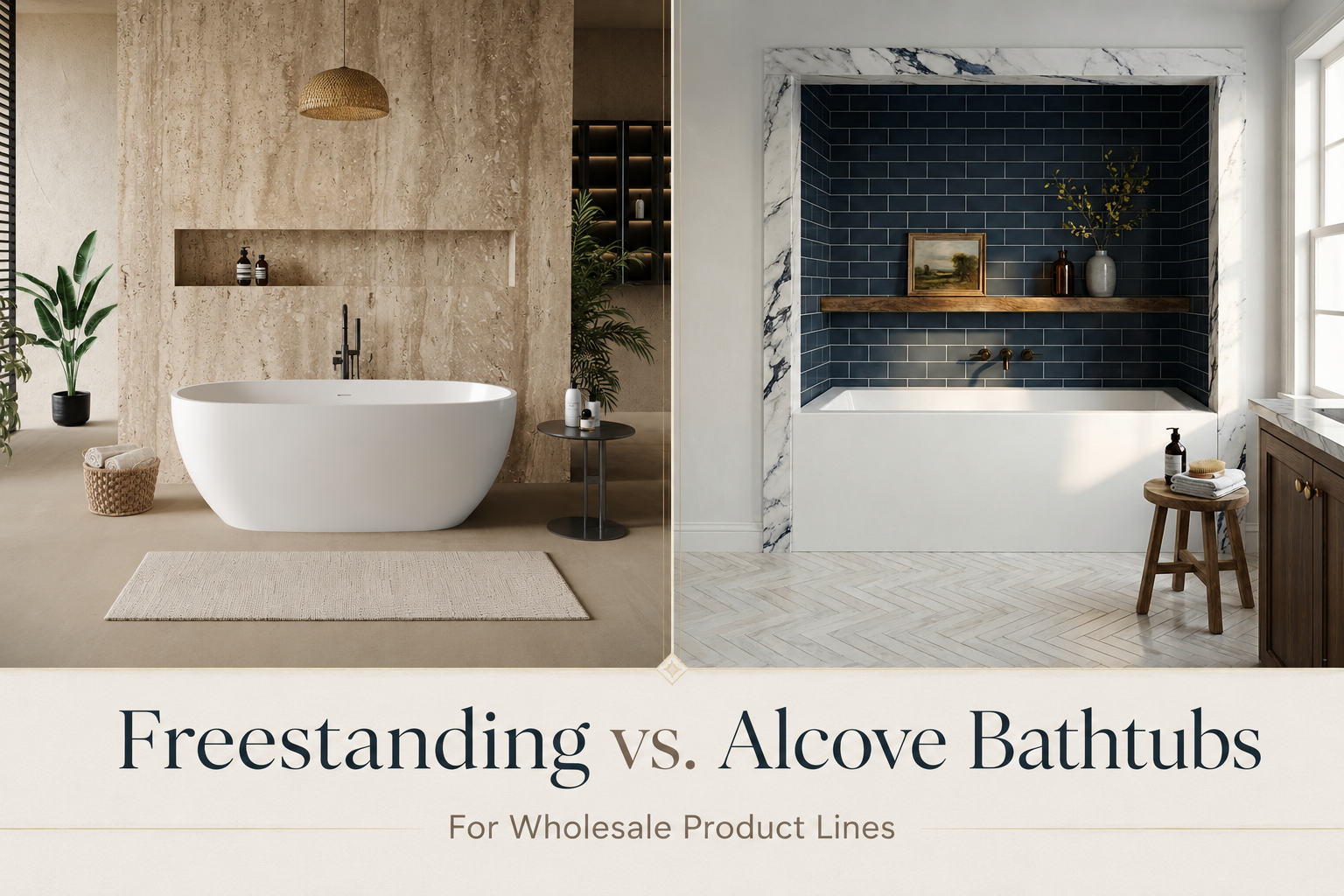
Freestanding vs. Alcove Bathtubs
| Comparison | Freestanding Bathtubs | Alcove Bathtubs |
|---|---|---|
| Market positioning | Premium and design-focused | Practical and project-focused |
| Installation | Independently placed | Installed between three walls |
| Visual impact | Strong | More functional |
| Typical bathroom size | Medium to large | Small to medium |
| Retail price | Usually higher | Usually more accessible |
| Product differentiation | Stronger through shape | Stronger through specifications |
| Packaging volume | Often larger | Can be more efficient |
| Main sales channels | Showrooms and premium retail | Builders, distributors, and projects |
| Wholesale role | Brand image and margin | Volume and repeat demand |
What Are Freestanding Bathtubs?
Freestanding bathtubs are designed to stand independently rather than being enclosed between walls.
Because the full exterior remains visible, the product’s shape, rim, proportions, and surface finish become important parts of its market appeal.
Common options include:
- Oval freestanding bathtubs
- Rectangular freestanding bathtubs
- Back-to-wall models
- Thin-edge designs
- Wide-rim designs
- Matte and glossy finishes
- One-piece and two-piece structures
Representative models can be reviewed through Salvere’s freestanding acrylic bathtub collection.
Why Add Freestanding Bathtubs to a Wholesale Line?
1. Stronger Visual Differentiation
Freestanding tubs often become the focal point of the bathroom.
They are suitable for:
- Showroom displays
- Lifestyle photography
- Premium catalogs
- Design-led collections
- New product launches
Their visible shape gives brands more opportunities to differentiate through rim thickness, exterior curves, proportions, and finishes.
2. Higher Perceived Value
Freestanding bathtubs are commonly positioned at a higher retail price than standard built-in tubs.
This can support:
- Better margins
- Premium product tiers
- Exclusive collections
- Stronger brand presentation
However, customers will also expect better surface quality, consistent shape, refined edge finishing, and secure packaging.
3. More Design Options
A freestanding collection can include different:
- Shapes
- Lengths
- Bathing depths
- Backrest angles
- Drain positions
- Rim structures
- Surface finishes
This makes the category useful for building a more distinctive product portfolio.
Wholesale Considerations for Freestanding Bathtubs
Freestanding products may require more attention to logistics and inventory.
Packaging and Shipping
Because the complete exterior must be protected, packaging may require:
- Additional foam
- Stronger cartons
- Rim and corner protection
- More warehouse space
- Careful container loading
Some freestanding structures can be nested or stacked, while sculptural designs may require individual packaging.
Surface Expectations
The complete bathtub remains visible after installation.
Buyers should pay particular attention to:
- Scratches
- Color consistency
- Gloss or matte uniformity
- Visible seams
- Rim finishing
- Inner- and outer-shell alignment
Market-Specific Demand
A design that performs well in one market may not perform equally well in another.
Wholesalers should evaluate local bathroom size, customer preferences, price expectations, and retail channels before adding too many similar freestanding models.
What Are Alcove Bathtubs?
Alcove bathtubs are normally installed between three surrounding walls.
They are commonly used in:
- Apartments
- Residential renovations
- Family bathrooms
- Builder projects
- Multi-unit developments
- Space-limited bathrooms
Unlike freestanding tubs, alcove models are often selected primarily according to installation specifications rather than exterior shape.
Buyers can review suitable products through the Salvere alcove bathtub collection.
Why Add Alcove Bathtubs to a Wholesale Line?
1. Stronger Volume Potential
Alcove bathtubs are closely connected with construction, renovation, and replacement demand.
They are well suited to:
- Builders
- Contractors
- Property developers
- Home-improvement retailers
- Regional distributors
Their practical role can create more stable and repeatable demand than highly design-specific products.
2. Better Space Efficiency
Because the bathtub fits between walls, it works well in bathrooms where an independent tub would occupy too much space.
This makes alcove products relevant for:
- Apartments
- Urban housing
- Standard residential layouts
- Renovation projects
3. Easier Product Standardization
An alcove product line can be organized around clear installation requirements, such as:
- Left-hand drain
- Right-hand drain
- Standard lengths
- Tub depth
- Skirt or apron structure
- Wall flange
- Overflow position
This makes the range easier for distributors, contractors, and project buyers to understand.
4. Potentially Better Logistics
Depending on the structure, some alcove and skirted tubs can be stacked more efficiently than fully assembled freestanding products.
For high-volume programs, better container utilization can reduce freight cost per unit.
Wholesale Considerations for Alcove Bathtubs
Alcove tubs may offer less visual differentiation, so technical details become more important.
Buyers should compare:
- Interior bathing space
- Product depth
- Rim design
- Drain orientation
- Front apron
- Wall flange
- Structural support
- Installation dimensions
Small differences in dimensions or drain position may create major installation problems.
For project sales, accurate technical drawings and installation instructions are often just as important as product images.
Which Category Is Better for Your Customers?
Freestanding Bathtubs Are More Suitable When:
- Your customers include premium retailers
- Showroom presentation is important
- The market has larger bathroom spaces
- Product differentiation is a priority
- You want to strengthen brand image
- Higher margin is more important than maximum volume
Alcove Bathtubs Are More Suitable When:
- Your customers include builders and contractors
- Renovation demand is important
- Standard installation sizes dominate the market
- Space efficiency is a priority
- You need repeatable, high-volume products
- Practicality and price are major purchasing factors
A Balanced Wholesale Product-Line Strategy
Many wholesalers should avoid choosing only one category.
A compact but balanced range might include:
Freestanding Collection
- One compact model
- One standard oval model
- One rectangular model
- One thin-edge premium design
- One wide-rim model
Alcove Collection
- One standard left-drain model
- One standard right-drain model
- One compact apartment model
- One deeper soaking model
- One project-focused skirted model
The goal is not to offer as many SKUs as possible.
Each model should serve a clear customer, installation condition, price range, or sales channel.
Questions to Ask Before Selecting Models
Before finalizing a wholesale collection, consider:
- Who are the main customers?
- Is the product intended for retail or projects?
- Which bathtub sizes sell most consistently?
- How common are compact bathrooms in the market?
- Are left- and right-drain versions required?
- How important is visual exclusivity?
- What retail price range is realistic?
- How many units fit into a container?
- Can the products be stacked or nested?
- Which models can share components or packaging?
These questions can prevent the collection from becoming too repetitive or difficult to manage.
How Salvere Supports Wholesale Bathtub Collections
Salvere manufactures freestanding, alcove, corner, two-sided, and skirted acrylic bathtubs in Ho Chi Minh City, Vietnam.
For wholesalers, importers, and private-label brands, our OEM/ODM acrylic bathtub solutions can support:
- Product-structure selection
- Size planning
- Drain-position options
- Rim and edge design
- Matte and glossy finishes
- Branding and labels
- Packaging development
- Container-loading evaluation
- Existing and custom mold projects
Our team can help buyers select models according to retail channel, project type, target market, logistics requirements, and expected sales volume.
Frequently Asked Questions
Which type usually offers better wholesale margins?
Freestanding bathtubs often support higher retail prices and margins, but they may also require more packaging, storage space, and marketing investment.
Alcove tubs may produce a lower margin per unit but offer stronger volume and repeat demand.
Which type is easier to sell in large quantities?
Alcove bathtubs are generally easier to standardize for builders, apartments, renovations, and residential projects.
Actual demand still depends on the country, housing type, and customer channel.
Should a new wholesaler start with freestanding or alcove bathtubs?
A design-focused retailer may begin with a small freestanding collection.
A distributor serving builders and contractors may benefit more from standardized alcove models.
The starting category should match the existing customer base.
Can both categories share one design language?
Yes.
A brand can coordinate interior curves, rim details, finishes, and proportions across freestanding and alcove products to create a more consistent collection.
Final Thoughts
Freestanding and alcove bathtubs perform different roles in a wholesale product line.
Freestanding bathtubs are stronger for:
- Design
- Brand image
- Premium positioning
- Higher perceived value
Alcove bathtubs are stronger for:
- Practical installation
- Project demand
- Space efficiency
- Repeatable volume
For many importers and distributors, the best strategy is not choosing one category over the other.
It is selecting the right models from each category so that design-focused products and volume-focused products support the same overall business.
Contact Salvere to discuss your wholesale acrylic bathtub collection.


