
An exclusive bathtub collection should offer more than several products with different shapes.
For bathroom brands, importers, and distributors, a successful collection needs a clear design language, defined market positioning, practical product sizes, and enough differentiation to avoid direct comparison with standard catalog models.
Exclusivity can come from a completely custom bathtub mold, but it can also be created through a coordinated combination of product structure, dimensions, rim details, finishes, fittings, branding, and packaging.
Based on Salvere’s experience supporting OEM and ODM acrylic bathtub projects, this guide explains how brands can develop a distinctive collection that is also practical to manufacture and scale.
Buyers deciding whether to use factory tooling or invest in new designs can first review our guide on existing molds versus custom bathtub molds.
Quick Answer
To develop an exclusive bathtub collection:
- Define the target customer and price position
- Establish one clear design language
- Select the right product types and sizes
- Decide which features require custom molds
- Coordinate shapes, rims, drains, and finishes
- Review manufacturing and packaging feasibility
- Protect mold ownership and product exclusivity
- Approve samples and complete pilot production
- Launch a focused collection instead of too many similar models
The strongest collection is not necessarily the largest.
It is a carefully planned range in which every bathtub has a clear commercial role while still appearing to belong to the same brand.
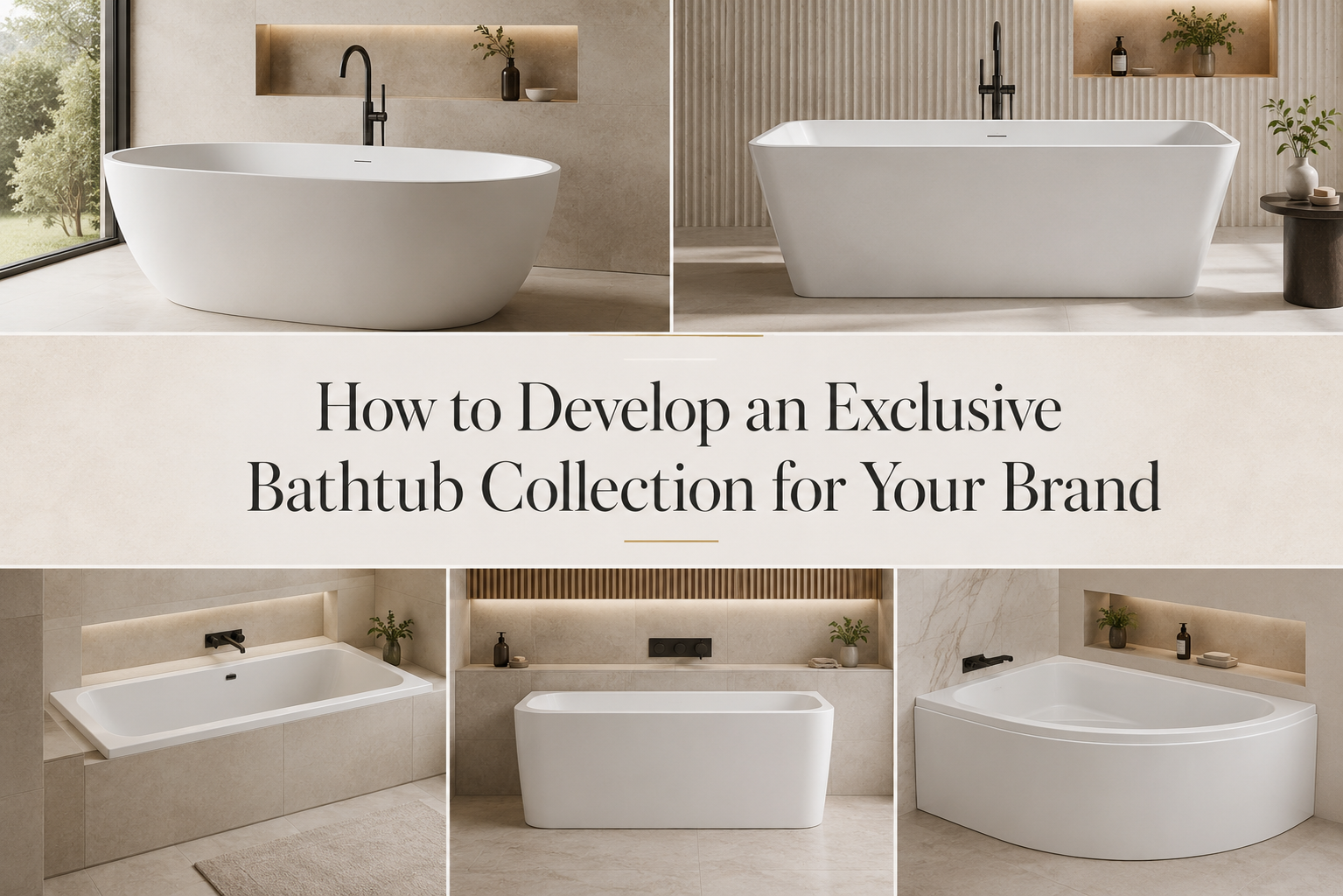
What Makes a Bathtub Collection Exclusive?
An exclusive collection should be difficult to compare directly with ordinary market products.
Differentiation may come from:
- Original bathtub shapes
- Brand-specific proportions
- Thin or wide rim profiles
- Distinctive backrest angles
- Custom drain positioning
- Coordinated matte or glossy finishes
- Exclusive dimensions
- Unique outer-shell details
- Customer-specific fittings
- Branded labels and packaging
Full exclusivity usually requires customer-funded tooling and a clear mold-ownership agreement.
However, brands with a lower starting budget can still create partial differentiation by combining selected existing molds with exclusive finishes, components, packaging, and product positioning.
Define the Target Market First
Product development should begin with the customer—not with the mold.
Before selecting designs, clarify:
- Target country or region
- Main sales channel
- Customer type
- Typical bathroom size
- Preferred installation type
- Expected retail price
- Project or retail focus
- Annual sales target
A premium showroom collection will require different products from a range intended for builders, apartment projects, or home-improvement retailers.
For example:
| Target Channel | Suitable Product Direction |
|---|---|
| Premium showroom | Sculptural freestanding tubs and refined rim details |
| Wholesale distribution | Proven sizes, practical designs, and efficient packaging |
| Apartment projects | Compact, alcove, skirted, and space-efficient models |
| Hospitality | Comfortable soaking depth and consistent project specifications |
| Design-led brand | Custom forms, exclusive finishes, and coordinated proportions |
A clear market position prevents the collection from becoming a random group of attractive products.
Create a Consistent Design Language
A collection should have visual relationships between its products.
This does not mean every bathtub should look identical.
Instead, selected elements can be repeated across different models, such as:
- Similar rim thickness
- Matching corner radiuses
- Consistent exterior curves
- Related backrest profiles
- Coordinated drain covers
- One surface-finish direction
- Similar visual proportions
For example, a brand may develop a collection around:
- Soft oval shapes and thin edges
- Clean rectangular forms and wide rims
- Organic curves and matte surfaces
- Compact proportions for urban bathrooms
A recognizable design language helps customers understand that the models belong to one product family.
Build the Right Product Structure
A collection should serve different needs without creating unnecessary SKU overlap.
A focused starting range might include:
- One compact freestanding bathtub
- One standard-size freestanding bathtub
- One premium statement model
- One back-to-wall or two-sided model
- One alcove or skirted project bathtub
The exact mix depends on the brand’s customer base.
Before selecting each product, ask:
What role does this model perform that the other models do not?
Possible roles include:
- Entry-level price point
- Compact bathroom solution
- Premium showroom model
- High-volume wholesale product
- Project-focused bathtub
- Distinctive hero product
Salvere manufactures freestanding, alcove, corner, two-sided, and skirted acrylic bathtubs. Buyers can review different starting structures in the Salvere acrylic bathtub collection.
Choose Existing or Custom Molds Strategically
Not every bathtub in the collection needs a completely new mold.
Brands can use three development approaches.
Existing-Mold Collection
Suitable for:
- Faster market entry
- Lower development cost
- Initial market testing
- Smaller starting volume
Differentiation can come from finishes, fittings, branding, packaging, and carefully selected product combinations.
Fully Custom Collection
Suitable for:
- Strong design ownership
- Premium market positioning
- Stable expected volume
- Long-term collection planning
- Exclusive retail programs
This approach provides greater control but requires more development time and investment.
Hybrid Collection
A practical strategy is to combine:
- Existing molds for commercial core models
- Custom molds for hero products
- Exclusive outer shells or details
- Coordinated finishes and packaging
This helps balance cost, launch speed, and brand differentiation.
Develop the Collection as a System
Each bathtub should not be developed in isolation.
The complete range should be reviewed for consistency across:
- Product dimensions
- Bathing depth
- Rim design
- Drain location
- Overflow style
- Surface finish
- Accessories
- Logo placement
- Technical documents
- Packaging graphics
Standardizing selected components may also simplify purchasing and inventory.
For example, several models may share:
- The same drain fitting
- The same overflow finish
- Similar adjustable feet
- Common packaging labels
- One installation-manual format
This creates a more coordinated customer experience while reducing unnecessary operational complexity.
Balance Design With Manufacturing Feasibility
A unique design must still be suitable for acrylic thermoforming and stable mass production.
Before approving a custom model, the manufacturer should evaluate:
- Acrylic stretching
- Shell thickness distribution
- Mold release
- Rim stability
- Fiberglass reinforcement
- Steel-frame layout
- Inner- and outer-shell assembly
- Surface finishing
- Defect risk
- Production consistency
Highly complex curves, very thin edges, or unusual proportions may increase production difficulty and rejection rates.
Salvere evaluates custom products from both design and manufacturing perspectives. Learn more about the process in our guide on how a custom acrylic bathtub moves from sketch to mass production.
Consider Packaging and Logistics Early
An exclusive product may look successful in a showroom but become commercially difficult if it has poor container utilization.
During development, buyers should evaluate:
- External product dimensions
- Carton size
- Foam and edge protection
- Stackability or nesting
- Units per container
- Warehouse space
- Transportation-damage risk
- Mixed-model loading
A premium sculptural bathtub may justify a larger package.
However, core wholesale models should usually balance visual differentiation with more efficient logistics.
The collection may therefore include:
- Non-stackable hero products for brand presentation
- Stackable or compact models for volume programs
Confirm Ownership and Exclusivity
Before investing in custom tooling, the buyer and manufacturer should agree on:
- Who owns the mold
- Who pays for mold development
- Whether the mold can be used for other customers
- Which markets are protected
- Who is responsible for maintenance
- How long the mold will be stored
- What happens if cooperation ends
- Whether the design can be transferred
The agreement should distinguish between:
- Mold ownership
- Product exclusivity
- Market exclusivity
- Brand-specific components
- Intellectual-property ownership
Paying for a mold does not automatically define every exclusivity condition. These terms should be documented clearly before development begins.
Approve the Collection Through Samples and Pilot Production
Each model should be evaluated through a physical sample.
The review should include:
- Overall design
- Comfort and bathing space
- Dimensions
- Drain position
- Surface quality
- Rim profile
- Internal reinforcement
- Product stability
- Components
- Packaging
After sample approval, a small pilot batch should confirm that the design can be reproduced consistently.
The approved sample, technical drawing, bill of materials, surface standard, and packaging specification should become the production reference.
How Salvere Supports Exclusive Bathtub Collections
Salvere supports bathroom brands, importers, and distributors with acrylic bathtub development from our manufacturing facility in Ho Chi Minh City, Vietnam.
Our OEM/ODM acrylic bathtub solutions can include:
- Collection planning
- Existing-mold selection
- Custom mold development
- Product shape and size customization
- Rim and drain-position development
- Matte and glossy finishes
- Branding and labeling
- Packaging development
- Pilot production
- Mass-production support
Our objective is not simply to add more models to a catalog.
We help buyers develop a focused product range that balances brand identity, production feasibility, logistics, and long-term commercial potential.
Frequently Asked Questions
Does every product need a custom mold?
No.
A collection can combine existing molds, modified structures, exclusive finishes, and fully custom designs.
Custom molds are most valuable when the main bathtub shape is essential to brand differentiation.
How many models should an initial collection include?
There is no fixed number, but a focused initial collection is usually easier to launch and manage than a large range of similar products.
Each model should serve a different customer, space, price point, or sales channel.
Can one design language be used across different bathtub types?
Yes.
Rim profiles, interior curves, finishes, and proportions can connect freestanding, back-to-wall, alcove, and skirted products into one coordinated collection.
How can a brand protect an exclusive design?
Use clear agreements covering mold ownership, product usage, market protection, design files, and confidentiality before development begins.
Final Thoughts
An exclusive bathtub collection should combine three priorities:
Clear brand identity → practical product structure → reliable mass production
A visually distinctive product alone does not create a successful collection.
The range must also suit the target market, cover meaningful customer needs, support efficient logistics, and remain consistent during production.
Salvere helps global bathroom brands turn product ideas into coordinated acrylic bathtub collections manufactured in Vietnam.
Contact Salvere to discuss your exclusive bathtub collection.


