
Selecting an acrylic bathtub supplier is not only about comparing product catalogs, samples, and unit prices.
For bathroom brands, importers, distributors, and project buyers, the more important question is whether the factory can reproduce the approved product consistently across hundreds or thousands of units.
A good sample proves what a supplier produced once. A factory audit helps determine whether the same quality can be maintained during mass production.
Based on Salvere’s experience operating a Vietnam acrylic bathtub factory, this guide explains the key areas global buyers should examine before approving a new manufacturing partner.
Quick Answer
When auditing an acrylic bathtub factory, buyers should focus on eight areas:
- Factory authenticity and production ownership
- Raw material control
- Thermoforming and mold management
- Fiberglass reinforcement and internal structure
- Dimensional and surface-quality control
- Quality management and product certification
- Production capacity, packaging, and delivery
- OEM project management and change control
The objective is not simply to confirm that the factory owns production equipment.
The audit should establish whether the supplier can deliver:
- Consistent product quality
- Accurate dimensions and installation details
- Controlled materials and components
- Verifiable product compliance
- Predictable production capacity
- Export-ready packaging
- Reliable OEM and ODM project execution
Supplier audits are commonly used to evaluate whether a factory has the production systems, technical capability, and quality controls required to deliver orders consistently and meet relevant requirements.
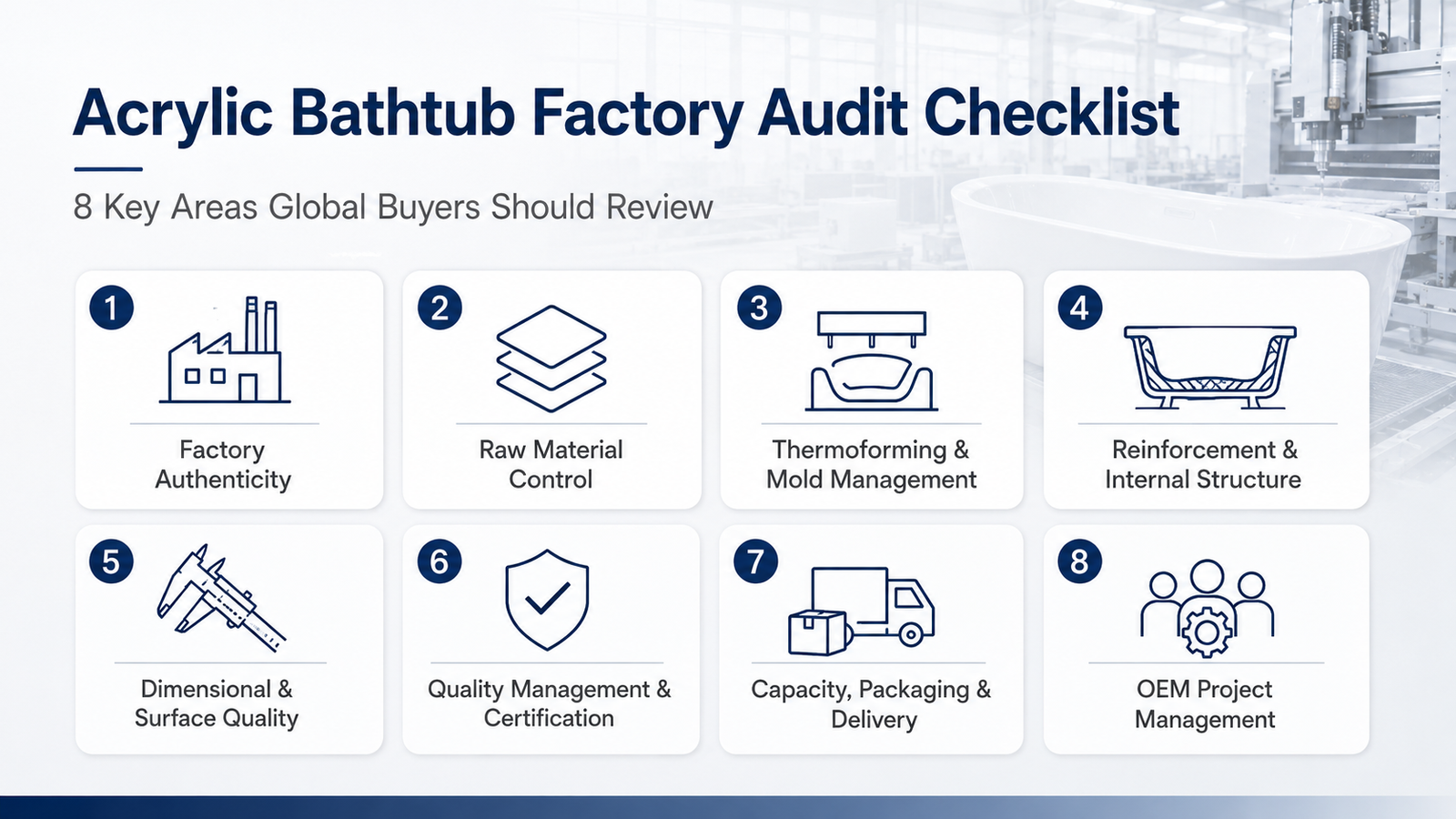
Acrylic Bathtub Factory Audit Checklist
| Audit Area | What Buyers Should Check | Warning Signs |
|---|---|---|
| Factory authenticity | Business information, factory address, employees, equipment, and internal processes | Showroom or assembly warehouse presented as a complete factory |
| Raw materials | Acrylic sheet, fiberglass, resin, frames, fittings, and batch records | Unlabeled materials or unclear material sources |
| Thermoforming | Heating, forming, cooling, demolding, and first-piece approval | Production controlled only by operator experience |
| Mold management | Mold identification, condition, maintenance, ownership, and revision status | Unmarked or damaged molds |
| Reinforcement | Fiberglass coverage, resin application, bottom support, steel frame, and feet | Uneven or incomplete reinforcement |
| Product accuracy | Dimensions, rim width, drain position, overflow position, and product stability | No tolerances or drilling fixtures |
| Quality control | Incoming, in-process, final, and outgoing inspections | Inspection performed only after production |
| Certification | Certificate holder, covered models, market, and current listing | Certification logo without verifiable model coverage |
| Capacity | Equipment, workers, bottlenecks, utilization, and current orders | Capacity based only on verbal claims |
| Packaging | Surface protection, carton structure, stacking, labels, and loading | Packaging developed without transport considerations |
| OEM management | Drawings, approved samples, specifications, and revision control | Product changes managed only through chat messages |
Verify the Actual Manufacturer
The first step is confirming that the supplier operates the manufacturing facility it claims to represent.
Buyers should verify:
- Registered company name
- Factory address
- Relationship between the factory and exporting company
- Number of production employees
- Main product categories
- Production-floor area
- Equipment ownership
- Processes completed internally
- Processes assigned to subcontractors
Outsourcing is not automatically a problem. However, the supplier should clearly disclose which processes are completed outside the audited facility and how those subcontractors are controlled.
For example, a supplier may complete bathtub assembly and packaging internally while outsourcing thermoforming or fiberglass reinforcement. In that situation, the facility does not control the complete production process.
Evidence to Request
Ask the supplier to provide:
- Business registration documents
- Factory organization chart
- Equipment list
- Production-flow chart
- Subcontractor information
- Recent production records
- Recent shipping records
During the factory tour, compare these documents with what is actually happening on the production floor.
Equipment that is displayed but not operational, unusually empty production areas, or products that cannot be matched to current production should be investigated further.
Check Raw Material Control
The quality of an acrylic bathtub depends on more than its visible acrylic surface.
Important materials and components may include:
- Acrylic sheet
- Fiberglass
- Resin
- Baseboard
- Steel frame
- Adjustable feet
- Adhesives
- Drain and overflow fittings
- Protective film
- Cartons and packaging materials
The factory should have defined specifications for these materials and an approved supplier-management process.
What Buyers Should Review
- Acrylic sheet specifications
- Material thickness requirements
- Supplier and batch identification
- Incoming inspection records
- Resin and adhesive storage
- Material shelf-life control
- Separation of approved and rejected materials
- Traceability between material batches and production orders
- Approval procedures for changing suppliers or components
One important question is:
Can the factory replace an approved acrylic sheet, fitting, frame, or other component without written buyer approval?
For a controlled OEM project, the answer should be no.
A material change may affect product appearance, structural performance, installation, certification, packaging, or cost. Important substitutions should therefore be documented and approved before use.
Inspect Thermoforming and Mold Management
Thermoforming is one of the most important processes in acrylic bathtub production.
A flat acrylic sheet is heated and formed into the bathtub shell. During forming, the material stretches differently across the product, particularly around deep bathing areas, narrow curves, corners, and complex transitions.
The audit should examine how the factory controls:
- Sheet positioning
- Heating temperature and time
- Forming pressure or vacuum
- Cooling time
- Demolding
- Shell appearance
- Highly stretched areas
- First-piece approval
- Process adjustments
Buyers should inspect both finished bathtubs and newly formed shells. The formed shell often provides a clearer view of surface waviness, uneven stretching, or shape inconsistencies.
Mold Management
Each mold should have clear identification connected to:
- Product model
- Drawing revision
- Maintenance status
- Storage location
- Inspection records
- Ownership information
For custom molds, buyers should also confirm:
- Who owns the mold?
- Can it be used for another customer?
- Who is responsible for maintenance?
- How long will the factory retain it?
- What happens if it is damaged?
- Can it be transferred if the manufacturing relationship ends?
Poorly identified or poorly maintained molds can lead to inconsistent product dimensions and surface quality.
Examine Reinforcement and Internal Structure
The visible acrylic shell is only one part of the bathtub.
Fiberglass, resin, support boards, steel frames, and adjustable feet all influence product rigidity, stability, and long-term performance.
During the audit, buyers should inspect unfinished products before the internal structure is covered by the outer shell or decorative panel.
Key Inspection Points
- Fiberglass coverage
- Reinforcement around the bathtub bottom
- Reinforcement around the rim
- Resin distribution
- Drain-area reinforcement
- Baseboard position
- Steel-frame structure
- Frame welding
- Adjustable-foot installation
- Inner- and outer-shell connection
- Stability when pressure is applied
The factory should have a defined reinforcement requirement for each model.
Reinforcement should not depend entirely on an individual worker deciding where to apply more or less material.
For larger, deeper, or structurally complex bathtubs, buyers should also ask whether the reinforcement standard changes according to product size and design.
Review Dimensional and Surface-Quality Control
Small dimensional differences can create major installation problems.
Important measurements may include:
- Overall length and width
- Product height
- Rim width
- Interior bathing dimensions
- Drain-hole position
- Overflow-hole position
- Faucet-hole position
- Frame height
- Adjustable-foot range
- Alignment between inner and outer shells
The factory should use approved drawings, defined tolerances, measuring tools, fixtures, templates, or CNC equipment according to the product requirements.
Salvere uses CNC cutting and drilling to improve the consistency of shell trimming and hole positioning. Buyers can learn more about these manufacturing stages on our acrylic bathtub production and factory page.
Documents to Review
- Approved technical drawing
- Product tolerance standard
- First-piece inspection report
- In-process measurement record
- Final inspection report
- Measuring-tool calibration record
- Cutting or drilling instructions
Surface-Quality Standards
Buyers should also establish clear standards for:
- Scratches
- Bubbles
- Pinholes
- Surface waviness
- Color differences
- Uneven gloss
- Polishing marks
- Visible seams
- Edge irregularities
- Protective-film damage
A requirement such as “the surface must look good” is too subjective for mass production.
A more reliable approach is to approve:
- A physical golden sample
- High-resolution reference photos
- Defined inspection lighting
- Inspection distance and angle
- Acceptable defect limits
- Separate standards for matte and glossy finishes
Review Quality Management and Certification
Quality should be controlled throughout production, not only after the bathtub is completed.
A factory’s quality process may include:
- Incoming material inspection
- First-piece approval
- In-process inspection
- Dimensional inspection
- Surface inspection
- Structural inspection
- Final product inspection
- Packaging verification
- Non-conforming product control
- Corrective-action records
ISO 9001 provides a framework for establishing, maintaining, and continually improving a quality management system. However, buyers should verify how that system is implemented in daily production rather than relying only on the certificate.
A useful audit question is:
Can you show us a recent quality problem and explain how it was identified, contained, investigated, and prevented from happening again?
A factory with an active quality-management system should be able to provide a clear example.
Verify Product Certification Carefully
A certification logo in a catalog does not prove that every model is covered.
Buyers should verify:
- Certificate holder
- Factory name and address
- Certification number
- Product category
- Covered models
- Applicable market
- Current listing status
IAPMO states that products carrying the UPC mark comply with applicable American requirements, while the cUPC mark covers applicable American and Canadian codes and standards. Buyers should still verify that the specific product model appears in the relevant listing.
Warning signs include:
- The supplier provides only a certification logo
- The certificate belongs to another company
- The certificate covers a different product type
- The ordered model is not listed
- The certification status cannot be independently confirmed
Evaluate Capacity, Packaging, and Delivery
Production capacity should not be evaluated through a single number in a company presentation.
Actual output depends on:
- Thermoforming equipment
- Available molds
- Forming cycle time
- Reinforcement capacity
- Assembly capacity
- Number of skilled workers
- Current factory utilization
- Existing customer orders
- Product complexity
- Packaging capacity
- Equipment maintenance
The slowest production stage usually determines the factory’s actual output.
Buyers should ask:
- What was the average monthly output during the last six months?
- How much capacity is currently committed?
- Which production stage is the main bottleneck?
- How much capacity is available for this project?
- What happens if critical equipment stops?
- How are production delays communicated?
Packaging and Container Loading
Bathtubs are large products that can be vulnerable to scratches, edge damage, movement, and carton failure during international transportation.
The audit should examine:
- Surface protection
- Protective film
- Foam position and thickness
- Rim and corner protection
- Accessory packaging
- Carton structure
- Product orientation
- Stacking limits
- Shipping marks
- Barcode accuracy
- Container-loading method
A lower product price may not reduce the buyer’s total cost if the bathtub has poor container utilization or a high transportation-damage rate.
Packaging, loading quantity, and product structure should therefore be evaluated together.
Buyers can also review Salvere’s different freestanding, alcove, corner, and skirted models through our acrylic bathtub product collection.
Review OEM Project and Change Management
Large brands often require more than a standard catalog product.
A bathtub OEM or ODM project may involve changes to:
- Dimensions
- Shape
- Rim structure
- Drain position
- Overflow position
- Faucet-hole arrangement
- Surface finish
- Color
- Logo
- Accessories
- Labels
- Packaging
- Installation instructions
The factory should have a controlled method for transferring these requirements into production.
Documents to Check
- Product requirement sheet
- Approved technical drawing
- Bill of materials
- Sample-approval record
- Golden-sample identification
- Packaging specification
- Label artwork
- Revision history
- Engineering-change record
- Mass-production approval
Email and instant messages may be useful during development, but final decisions should be recorded in controlled production documents.
At Salvere, our OEM/ODM acrylic bathtub solutions cover customization involving molds, product dimensions, rim structures, drain positions, finishes, branding, and packaging. Buyers can review how these requirements are transferred from product development to mass production during a factory audit.
What Buyers Can Review at Salvere’s Vietnam Factory
Salvere operates a 14,000-square-meter acrylic bathtub manufacturing facility in Ho Chi Minh City, Vietnam, with approximately 150 employees and monthly production capacity exceeding 6,000 bathtubs.
During a factory visit, buyers can review:
- Acrylic sheet preparation
- Thermoforming and demolding
- CNC cutting and drilling
- Fiberglass and resin reinforcement
- Support-board and steel-frame installation
- Bathtub assembly
- Surface finishing
- Quality inspection
- Packaging
- Container loading
- OEM and ODM sample development
Factory size and production figures should not be the only basis for supplier approval.
We encourage buyers to examine the actual production flow, equipment, workers, inspection methods, and project-management procedures behind these figures.
Common Factory Audit Red Flags
Buyers should investigate further when they observe several of the following issues:
- Core production processes are outsourced without disclosure
- Raw materials have no batch identification
- Different departments use different drawing revisions
- Molds have no clear identification or maintenance records
- Fiberglass reinforcement varies significantly between units
- Drain and overflow holes are positioned without defined measurements
- Quality standards depend entirely on individual judgment
- Certificates cannot be independently verified
- Production capacity is supported only by verbal claims
- Approved sample changes are not formally recorded
One issue does not automatically disqualify a supplier.
However, several connected problems may indicate that production depends more on individual experience than on a repeatable manufacturing system.
Frequently Asked Questions
How long does an acrylic bathtub factory audit take?
A focused technical and quality audit can usually be completed within one working day.
A broader audit covering social responsibility, environmental management, security, and detailed compliance may require more time.
Can a virtual audit replace an on-site factory visit?
A virtual audit can help buyers review documents, major equipment, and the general production flow during the early supplier-screening stage.
However, it is more difficult to verify material storage, production discipline, hidden outsourcing, and record consistency remotely.
For high-volume or long-term cooperation, an on-site audit is more reliable.
Should buyers use a third-party auditor?
A third-party audit can be useful when the buyer does not have local technical personnel.
However, the checklist should be customized for acrylic bathtub manufacturing. A general audit may not examine thermoforming, reinforcement, drain-position accuracy, surface standards, or bathtub packaging in sufficient detail.
Is ISO 9001 certification enough to approve a factory?
No.
ISO 9001 can demonstrate that a quality-management framework has been established, but buyers should still verify how the factory controls materials, production, inspections, non-conforming products, and corrective actions.
Final Thoughts
An effective acrylic bathtub factory audit should answer one central question:
Can this supplier consistently manufacture the approved bathtub according to the required quality, specification, compliance, volume, and delivery schedule?
A showroom demonstrates how a product can look.
A sample demonstrates what the supplier produced once.
A factory audit shows whether the same result can be repeated during mass production.
For global bathroom brands and importers, the strongest manufacturing partner is not always the supplier offering the lowest initial quotation.
A more reliable partner is one that provides:
- Transparent production processes
- Stable material and quality control
- Accurate execution
- Verifiable compliance
- Predictable delivery
- Controlled OEM project management
Salvere welcomes bathroom brands, importers, distributors, and project buyers to review our acrylic bathtub manufacturing facility in Vietnam.


