
As the head of Salvere, an OEM/ODM acrylic bathtub factory, I've spent nearly two decades in the sanitary ware industry. I've guided countless global bathroom brands through the complexities of manufacturing, helping them turn concepts into high-quality, market-ready products. This guide distills my experience, offering you a clear roadmap to navigate the OEM/ODM landscape, avoid common pitfalls, and forge a successful partnership. Whether you're a new brand or an established one looking to diversify, understanding these steps is crucial for your success.
To successfully partner with an acrylic bathtub OEM/ODM manufacturer, global bathroom brands must first precisely define their product requirements and target market, while clarifying their business model (OEM vs. ODM). It is crucial to vet potential factories for key capabilities, including production capacity, technological expertise, and robust quality control systems with relevant international certifications. Brands must then evaluate customization options, understand lead times, clarify cost structures, and assess supply chain stability. Meticulous preparation and due diligence ensure the selection of a reliable partner that aligns with brand strategy, drives innovation, and guarantees consistent, compliant product delivery.
Let's walk through the essential considerations for global bathroom brands seeking an effective OEM/ODM partner for acrylic bathtubs.
What to Prepare Before Choosing an OEM/ODM Manufacturer
Clarity is your compass.
Before approaching an acrylic bathtub OEM/ODM manufacturer, global bathroom brands must meticulously prepare a detailed brief outlining their precise product requirements, target market, and strategic goals. This includes defining specific dimensions, design aesthetics, desired features, material specifications (e.g., acrylic thickness), and target price points. Furthermore, clarity on branding, packaging needs, and expected production volumes is crucial. Thorough preparation ensures efficient communication, allows the manufacturer to provide accurate quotes and viable solutions, and fundamentally sets the foundation for a productive and successful manufacturing partnership, avoiding misunderstandings and delays.
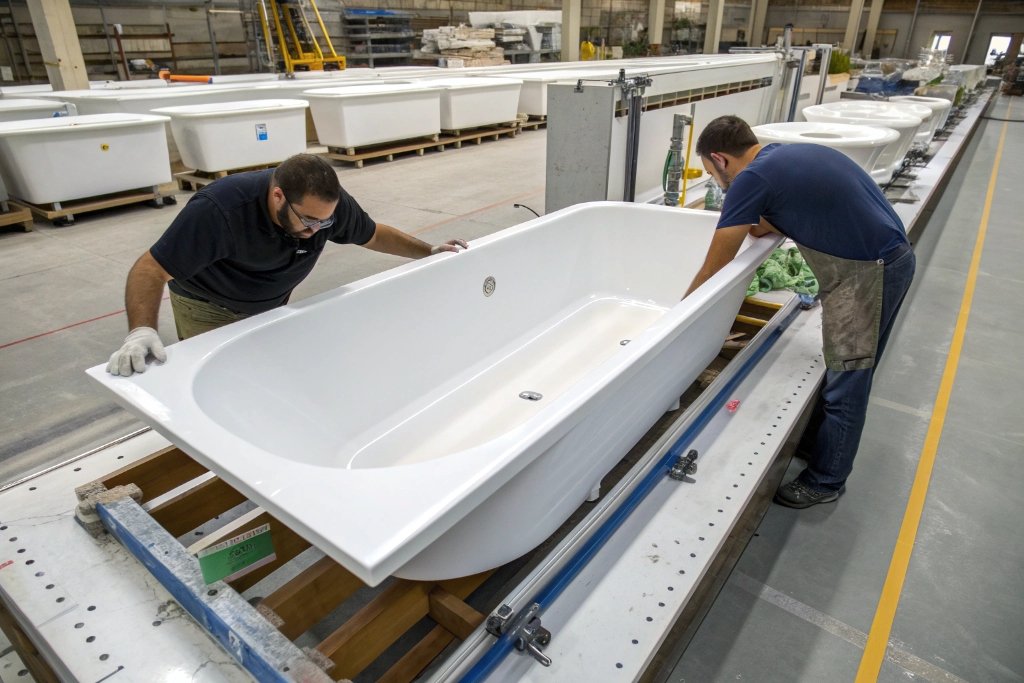
The success of your OEM/ODM partnership starts long before you even contact a factory. Preparation is key.
- Define Your Product Specifications (in detail):
- Bathtub Type: Freestanding, alcove, drop-in, corner, walk-in?
- Dimensions: Exact length, width, height, and soaking depth. Provide sketches, CAD files, or reference images.
- Design Language: Modern, traditional, transitional? Any specific curves, angles, or apron styles?
- Features: Simple soaker, air jets, whirlpool system, chromotherapy, heating? Specify any preferred component brands.
- Material Specifications: Desired acrylic sheet thickness (e.g., 3.2mm, 4mm, 5mm), type of reinforcement (fiberglass/resin or foam), frame material.
- Finish: High gloss, matte (if applicable for acrylic)?
- Accessories: Required drain and overflow type, faucet drilling, hardware finish (chrome, matte black, brushed nickel).
- Weight Capacity/Load Bearing: Any specific requirements based on intended use.
- Understand Your Target Market:
- End-Users: Luxury, mid-range, budget-conscious? Commercial or residential?
- Geographic Market: North America, Europe, Australia? This dictates crucial certifications and design preferences.
- Price Point: What is the target retail price range for your product? This helps the manufacturer suggest appropriate materials and features to meet your budget.
- Clarify Your Brand's Vision and Values:
- Branding: How will your logo be incorporated? What are your packaging requirements?
- Sustainability: Are there any specific environmental mandates or sustainable material preferences?
A comprehensive brief acts as your blueprint, ensuring the manufacturer understands your needs precisely.
Key Capabilities of a Reliable Acrylic Bathtub Factory
Beyond just making tubs.
Identifying the key capabilities of a reliable acrylic bathtub OEM/ODM factory is paramount for global brands. This includes assessing the factory's production capacity for consistent output, the modernity of its thermoforming and CNC trimming equipment for precision, and the adoption of intelligent automation for stable quality. Furthermore, a strong engineering team for product development, robust mold-making capabilities, and a proven track record of managing complex projects are essential. The manufacturer's financial stability, transparent communication, and commitment to continuous improvement signify a trustworthy long-term partner capable of fulfilling diverse and dynamic requirements.
A strong OEM/ODM partner offers more than just manufacturing; they bring expertise and reliability.
- Production Capacity and Scale:
- Volume: Can the factory consistently meet your required annual production volume without sacrificing quality or extending lead times? What are their daily/monthly output figures for similar products?
- Scalability: Can they scale up production if your product's demand unexpectedly increases?
- Modern Equipment and Technology:
- Thermoforming: Do they use state-of-the-art vacuum forming machines that ensure uniform acrylic thickness and precise feature replication?
- Trimming & Finishing: Are precision CNC machines used for accurate trimming, and what is the quality of their polishing and finishing processes?
- Automation: Does the factory utilize intelligent automation to enhance efficiency and reduce human error (e.g., robotic spraying for reinforcement, automated inspection systems)? At Salvere, we employ these technologies.
- Engineering and R&D Team:
- Expertise: Do they have experienced engineers capable of translating your designs into manufacturable products, optimizing for production efficiency and cost?
- Innovation: Can they provide suggestions for material improvements, feature integration, or help with new product development from concept to prototype?
- Mold-Making Capabilities:
- In-house or Outsourced: Do they have in-house mold development, which often speeds up the process and ensures better control, or do they rely on external partners?
- Quality: What is the quality and precision of their molds, as this directly affects the final product's finish and accuracy?
- Financial Stability and Track Record:
- Longevity: How long has the factory been in business? A long history often indicates stability.
- Client Base: Do they work with reputable global brands, indicating a level of trust and established quality?
Look for a manufacturer that invests in its capabilities and personnel, demonstrating a commitment to long-term quality and efficiency.
OEM vs. ODM: Choosing the Right Model
Your design, or theirs?
Choosing between OEM (Original Equipment Manufacturer) and ODM (Original Design Manufacturer) for acrylic bathtub production hinges on a brand's specific needs for control, design input, and speed to market. OEM is ideal for brands with existing designs and full intellectual property ownership, seeking a manufacturer to produce precisely to their specifications. ODM, conversely, suits brands that prefer to leverage the manufacturer's existing, proven designs, often with customization options, for faster product development and potentially lower tooling costs. The right model depends on a brand's internal design capabilities, budget, time constraints, and strategic vision for product differentiation and market entry.
Understanding the difference between OEM and ODM is crucial for defining your partnership with a manufacturer.
- Original Equipment Manufacturer (OEM):
- What it means: You provide the complete design, including specifications, drawings, and potentially even unique mold requirements. The manufacturer strictly produces to your exact specifications.
- Best for: Brands with strong in-house design and engineering capabilities, those with established product lines they want to reproduce, or brands seeking to maintain full intellectual property (IP) control over their designs.
- Advantages: Full control over product design, unique product differentiation, exclusive IP.
- Considerations: Higher upfront costs (for mold development if new) and longer lead times for initial setup.
- Original Design Manufacturer (ODM):
- What it means: The manufacturer has existing bathtub designs and molds that you can choose from. You can then customize these designs with your branding, specific features (like jets or a different drain type), or material finishes.
- Best for: Brands looking for faster time-to-market, those with limited in-house design resources, or those wanting to reduce initial development costs.
- Advantages: Lower tooling costs (as molds already exist), faster lead times for product development, access to the manufacturer's proven designs and engineering expertise.
- Considerations: Less unique product differentiation, shared IP on the base design.
At Salvere, we offer two types of services. Some clients come to us with complete CAD files for their new freestanding bathtubs, and we act purely as an OEM partner. Other brands choose our existing high-efficiency standard models and customize them by adding their preferred trim kits, creating their own unique products through our ODM service.
Your choice impacts cost, time, and the level of design control you retain. Choose the model that best fits your brand's resources and market strategy.
Customization and Mold Development Options
Making your vision real.
Evaluating customization and mold development options is vital for brands aiming for unique acrylic bathtubs that stand out in the market. A capable OEM/ODM partner should offer flexible customization, ranging from minor aesthetic adjustments like specific faucet drillings or skirt designs, to full-scale new product development requiring entirely new molds. This involves assessing the manufacturer's in-house mold-making expertise, their ability to translate complex design concepts into manufacturable forms, and the associated costs and lead times. A strong partner will provide clear communication and technical support throughout the mold development and customization process, ensuring your unique bathtub vision is realized with precision and efficiency.
Customization is often the key to differentiation in a competitive market.
- Types of Customization:
- Minor modifications: Changing drain/overflow positions, adding pre-drilled faucet holes, altering apron height, specific color choices (if applicable for acrylic), integrating brand-specific jets.
- Major modifications: Altering the basic shape, size, or depth of an existing model.
- New Product Development: Creating a completely new bathtub design from scratch, requiring new molds.
- Mold Development Process:
- Design Phase: Translating your concept into technical drawings and 3D models.
- Mold Production: Manufacturing the master mold (often from wood, then fiberglass or steel), which is then used for thermoforming.
- Prototyping: Producing initial samples from the new mold for your review and approval. This is a critical step for quality and design validation.
- Costs and Lead Times for Molds:
- Tooling Costs: For new molds, there are significant upfront tooling costs. These can vary widely based on the complexity and size of the bathtub.
- Lead Times: Mold development is one of the longest lead times in the process, often taking several weeks to months, depending on complexity.
- Who owns the IP?: Clarify intellectual property ownership of custom molds and designs in your contract.
A manufacturer’s flexibility in customization and their command over mold development directly impacts your ability to innovate and differentiate.
Quality Control, Certifications, and Compliance
The bedrock of trust.
Rigorously evaluating quality control, certifications, and compliance is absolutely essential for global bathroom brands choosing an acrylic bathtub OEM/ODM. This involves verifying the manufacturer's adherence to international standards like ISO 9001 for quality management, alongside specific product certifications crucial for your target markets (e.g., UPC for North America, CE for Europe, Watermark for Australia). A robust QC system, encompassing everything from raw material inspection and in-process checks to 100% water testing and final product audits, ensures consistent bathtub quality, durability, and safety. A transparent manufacturer will readily provide comprehensive documentation, building trust and confirming compliance with all necessary regulatory requirements.
For sanitary ware, quality and compliance are non-negotiable.
- Quality Management System (QMS):
- Does the factory operate under a recognized QMS (e.g., ISO 9001)? This indicates a structured approach to quality.
- What are their specific QC protocols at each stage:
- Incoming material inspection: Checking acrylic sheets, resins, and components.
- In-process checks: Monitoring thermoforming consistency, reinforcement application, trimming accuracy.
- Final inspection: Visual checks, dimensional accuracy, structural integrity, and crucial 100% water testing for leaks.
- International Product Certifications:
- North America: Is the factory certified to UPC (Uniform Plumbing Code) or IAPMO standards? This is vital for market entry.
- Europe: Does it comply with CE (Conformité Européenne) marking requirements?
- Australia/New Zealand: Does it meet Watermark certification?
- Other Standards: Are there any other regional or product-specific certifications your market requires (e.g., specific fire ratings, accessibility standards)?
- Traceability and Documentation:
- Can they trace raw materials to finished products?
- Do they provide thorough testing reports, material data sheets, and certification documents?
Always demand transparency and documented proof of quality processes and certifications.
Lead Time, Cost Structure, and Supply Chain Stability
The nuts and bolts of reliable supply.
Understanding lead time, cost structure, and supply chain stability is paramount for global bathroom brands seeking a reliable acrylic bathtub OEM/ODM. Lead time encompasses the entire cycle from order confirmation to delivery, crucially impacting inventory and market responsiveness. A transparent cost structure, with itemized pricing and clear payment terms, is essential for accurate budgeting. Furthermore, evaluating the manufacturer's supply chain stability—including diversified raw material sourcing, robust logistics, and contingency planning—mitigates risks of delays, cost fluctuations, and ensures consistent product flow. These factors collectively determine the partnership's efficiency, predictability, and overall long-term viability.
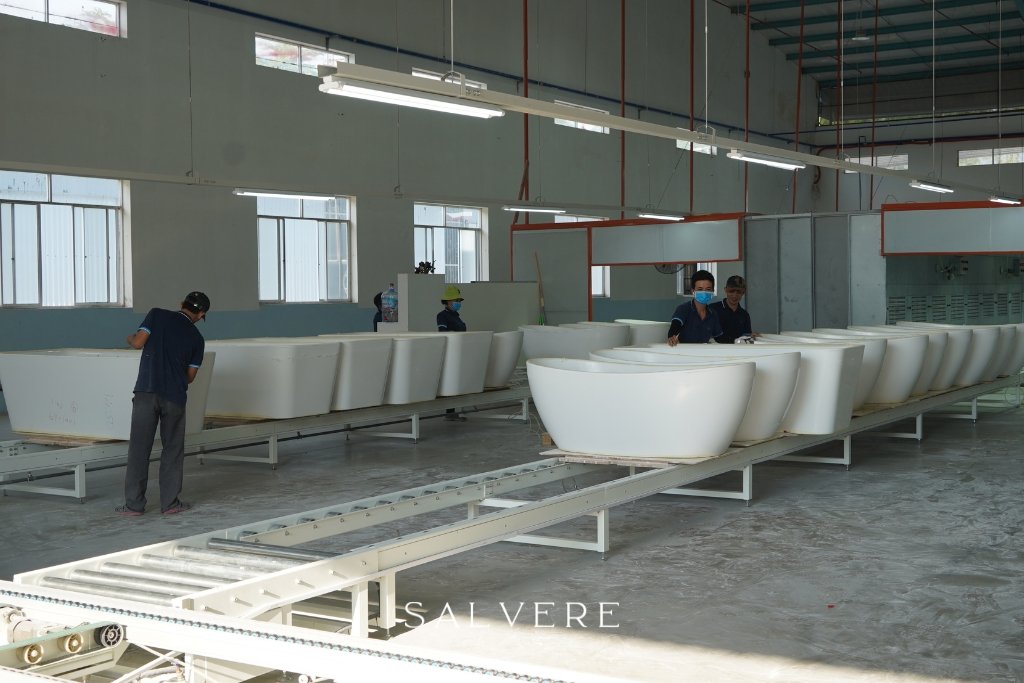
The operational aspects of manufacturing directly impact your business's efficiency and profitability.
- Lead Time:
- Sampling Lead Time: How long from concept finalization to receiving a final approved sample?
- Production Lead Time: What is the typical lead time from order confirmation to ex-factory shipment for your expected volume?
- Shipping Lead Time: What are typical ocean freight transit times to your target markets?
- Cost Structure:
- Quoting Transparency: Does the manufacturer provide clear, itemized quotes? Breakdown of unit cost, tooling cost, packaging cost, etc.
- Payment Terms: What are their standard payment terms (e.g., upfront deposit, percentage upon completion, balance before shipment)?
- Minimum Order Quantity (MOQ): What are their MOQs, and how flexible are they? MOQs impact unit cost.
- Ex-factory, FOB, or CIF: Clearly define the shipping incoterms to understand where costs and responsibilities transfer.
- Supply Chain Stability:
- Raw Material Sourcing: How diversified are their raw material suppliers? Do they have contingency plans for material shortages? Our base in Vietnam, for example, offers supply chain diversification.
- Logistics Network: Do they have established relationships with reliable freight forwarders? What are their strategies for mitigating shipping delays or port congestion?
- Communication: How do they communicate during production about potential delays or issues, and what are their resolution processes?
A reliable manufacturer provides clear communication and robust processes for these critical operational elements.
👉 Learn more about Salvere Bath OEM/ODM capabilities
and how we manufacture acrylic bathtubs in Vietnam.


