
Once an acrylic bathtub order is finished, it can be tempting to move directly to container loading.
But for importers, wholesalers, bathroom brands, and project buyers, the final stage before shipment is one of the most important points in the entire sourcing process.
A problem that is still inside the factory can usually be corrected.
A problem discovered after the container arrives may lead to:
- Replacement costs
- Customer complaints
- Installation delays
- Warehouse sorting
- Additional freight
- Project delays
- Damage to brand reputation
That is why pre-shipment inspection should not focus only on whether the bathtub “looks good.”
Buyers should confirm the product, dimensions, surface, structure, components, packaging, labels, quantity, and loading condition before the order leaves the factory.
Based on Salvere’s experience manufacturing acrylic bathtubs for international B2B buyers, this guide explains what should be checked before shipment and why each step matters.
Quick Answer
Before shipping an acrylic bathtub order, buyers should check:
- Product model and quantity
- Dimensions and drain position
- Acrylic surface quality
- Reinforcement and structural stability
- Drain and overflow components
- Product assembly
- Labels and accessories
- Packaging protection
- Carton information
- Final container loading
The most important principle is:
Do not inspect only the appearance of a few finished bathtubs. Confirm that the complete shipment matches the approved sample, technical drawing, packaging standard, and purchase order.
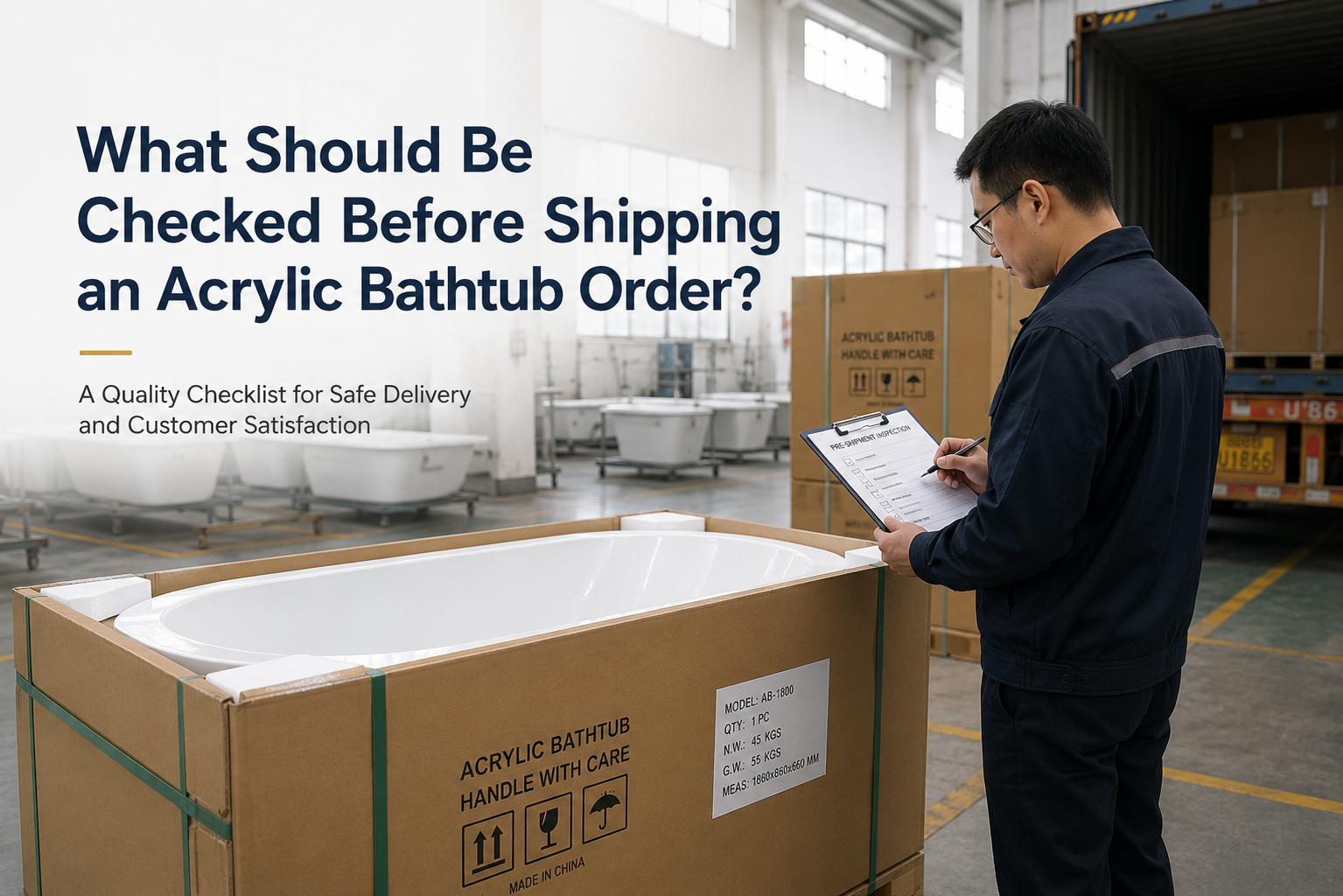
Pre-Shipment Inspection Overview
| Inspection Area | What Can Go Wrong | What Buyers Should Check |
|---|---|---|
| Model and quantity | Wrong SKU or missing units | PO, model number, quantity |
| Dimensions | Installation problems | Length, width, height, drain position |
| Surface | Scratches, gloss variation, color inconsistency | Finish under proper lighting |
| Structure | Flexing or instability | Reinforcement, frame, bottom support |
| Drain and overflow | Leakage or incorrect position | Hole accuracy, fittings, sealing |
| Accessories | Missing or incorrect parts | Packing list and accessory box |
| Packaging | Shipping damage | Carton, foam, corner and bottom protection |
| Labels | Warehouse or retail confusion | SKU, carton marks, barcodes |
| Loading | Damage or quantity errors | Stacking, orientation, container condition |
Confirm the Correct Model and Quantity
It sounds basic, but model and quantity mistakes still happen.
Large orders may contain:
- Several bathtub sizes
- Left- and right-drain versions
- Different finishes
- Different customer labels
- Similar-looking models
A warehouse team may not easily recognize the difference between two similar bathtub SKUs.
Why Does This Happen?
Common causes include:
- Similar model names
- Mixed production batches
- Last-minute order changes
- Incorrect carton labels
- Poor separation in the warehouse
What Buyers Should Check
Before shipment, compare finished goods with:
- Purchase order
- Final SKU list
- Approved product drawings
- Packing list
- Carton labels
For mixed-model containers, each model should be clearly identified and counted before loading.
Check Critical Dimensions and Drain Position
A bathtub can look perfectly acceptable and still create a serious installation problem if the dimensions are incorrect.
Important measurements may include:
- Overall length
- Overall width
- Product height
- Bathing depth
- Rim width
- Drain position
- Overflow position
- Frame height
- Adjustable-foot range
Why Is This Important?
For project and replacement orders, even small dimensional differences can affect installation.
Drain position is particularly important for:
- Alcove bathtubs
- Skirted bathtubs
- Left- and right-drain models
- Products designed for existing plumbing layouts
What Buyers Should Check
The inspector should compare actual measurements with the approved technical drawing, not only the catalog specification.
At least several units from the batch should be measured, especially for critical installation dimensions.
If the order contains customized drainage, buyers can also review our guide on how drain position affects bathtub design and installation.
Inspect the Acrylic Surface Under Proper Lighting
Surface defects are among the most visible problems after a bathtub reaches the customer.
Common issues include:
- Scratches
- Dull areas
- Uneven gloss
- Surface contamination
- Polishing marks
- Color variation
- Visible joint lines
- Edge-finishing problems
Why Are Surface Problems Easy to Miss?
Some defects are difficult to see in poor factory lighting.
A bathtub may look acceptable from one angle but show scratches or uneven finishing when viewed under stronger light.
Glossy and matte surfaces also require different inspection standards.
What Buyers Should Check
For glossy bathtubs:
- Reflection consistency
- Fine scratches
- Polishing quality
- Surface waviness
For matte bathtubs:
- Texture consistency
- Color uniformity
- Uneven sanding or finishing
Inspectors should view the product from different angles under adequate light.
Surface standards should ideally be agreed during sample approval rather than decided only at final inspection.
Check Reinforcement and Structural Stability
A finished bathtub may hide most of its reinforcement.
That makes it important to confirm structural requirements before products are completely packed.
Depending on the model, the inspector may need to review:
- Fiberglass coverage
- Resin application
- Bottom support
- Support boards
- Steel frame
- Adjustable feet
- Inner- and outer-shell connection
Why Does This Matter?
Weak reinforcement may not be obvious from the surface.
Problems may only appear later as:
- Flexing
- Instability
- Cracking
- Uneven support
- Installation complaints
What Buyers Should Check
The factory should compare the production structure with the approved sample and specification.
For large orders, buyers should not rely only on one finished unit.
Products from different stages of the batch should be compared to confirm that reinforcement remains consistent.
For more detail, see How to Evaluate Batch Consistency in Acrylic Bathtub Production.
Check Drain, Overflow, and Assembly
Drain and overflow problems can become expensive once the bathtub is installed.
Common issues include:
- Incorrect hole position
- Loose fittings
- Poor sealing
- Missing gaskets
- Wrong drain components
- Leakage
- Incorrect overflow orientation
Why Does This Happen?
Possible causes include:
- Inaccurate drilling
- Incorrect components
- Rushed assembly
- Different fitting batches
- Incomplete inspection
What Buyers Should Check
Confirm:
- Drain position
- Overflow position
- Component model
- Tightness
- Sealing
- Assembly direction
If the factory performs water testing or leakage testing, the buyer should understand:
- Which products are tested
- How the test is performed
- What criteria are used
For customized fittings, make sure the mass-production component matches the approved sample.
Verify Accessories, Labels, and Documents
A bathtub can pass quality inspection and still create problems if the wrong accessories are packed.
Depending on the order, each bathtub may include:
- Drain components
- Overflow components
- Adjustable feet
- Installation hardware
- Instruction manual
- Warranty card
- Branded labels
- Accessory box
What Can Go Wrong?
- Accessories missing
- Wrong drain included
- Incorrect instruction manual
- Barcode mismatch
- Wrong logo
- Wrong SKU label
These mistakes can create warehouse and retail problems even when the bathtub itself is correct.
What Buyers Should Check
Compare the finished package with:
- Approved accessory list
- Artwork
- Label file
- Barcode list
- Packing specification
For private-label programs, carton markings and product labels should be treated as part of the final product specification.
Inspect Packaging Before the Products Leave the Factory
Packaging quality directly affects whether the bathtub arrives in saleable condition.
International transportation exposes products to:
- Repeated handling
- Stacking pressure
- Container movement
- Warehouse transfer
- Long-distance delivery
What Buyers Should Check
Inspect:
- Carton strength
- Foam protection
- Edge protection
- Corner protection
- Bottom reinforcement
- Strapping
- Accessory positioning
- Carton closure
- Shipping marks
At Salvere, our export packaging can include 7-layer, 300-lb-grade cartons, 5 mm foam around the bathtub edges, a 5 mm wooden board at the bottom, and four L-shaped corner reinforcement bars, depending on the model and project requirements.
For suitable structures, this protection also supports controlled stacking during transportation.
You can read more in How to Reduce Bathtub Damage During International Shipping.
Compare the Final Product With the Approved Sample
One of the most useful final checks is also one of the simplest:
Place the production bathtub beside the approved sample.
Compare:
- Shape
- Color
- Surface finish
- Rim
- Drain
- Overflow
- Accessories
- Branding
- Packaging
Why Does This Matter?
Technical documents are important, but some differences are easier to recognize through direct visual comparison.
This is especially useful for:
- Custom colors
- Matte finishes
- Edge profiles
- Visible seams
- Outer-shell alignment
- Product proportions
The approved sample should remain the physical reference for mass production.
Review Defects Before Approving Shipment
Pre-shipment inspection should not simply produce a “pass” or “fail” result.
If defects are found, buyers should understand:
- What the defect is
- How many units are affected
- Why it happened
- Whether the issue affects other units
- How the supplier will correct it
- Whether reinspection is required
What Buyers Should Check
Ask for a clear defect record when necessary.
Typical defect categories may include:
- Critical defects
- Major defects
- Minor defects
The acceptance standard should ideally be agreed before production begins.
A supplier should not be defining acceptable quality for the first time after the order is already finished.
Check Container Loading Before Shipment
The final inspection does not end when the carton is closed.
Container loading is also part of shipment quality.
Problems can happen if:
- Products are stacked incorrectly
- Cartons move during transport
- Heavy goods are placed in the wrong position
- Container walls are damaged
- Product quantity is incorrect
- Packaging is damaged during loading
What Buyers Should Check
Before the container leaves the factory, confirm:
- Container number
- Container condition
- Product quantity
- Model mix
- Loading direction
- Stack height
- Product protection
- Final door closure
- Seal number
Loading photos are also useful for record keeping and future claims.
For high-volume programs, container loading should follow a repeatable plan rather than being decided each time on the loading day.
Pre-Shipment Checklist for Acrylic Bathtub Buyers
| Area | Final Check |
|---|---|
| PO | Correct model and quantity |
| Product | Matches approved sample |
| Dimensions | Critical dimensions within tolerance |
| Drain | Correct position and component |
| Surface | No unacceptable scratches or finish issues |
| Structure | Reinforcement and support confirmed |
| Assembly | Drain, overflow, feet, frame properly installed |
| Accessories | Complete and correct |
| Branding | Logo, labels, manuals correct |
| Packaging | Protection matches approved specification |
| Carton | SKU, marks, barcode correct |
| Quantity | Final count confirmed |
| Container | Clean, undamaged, properly loaded |
| Records | Inspection and loading photos retained |
How Salvere Approaches Pre-Shipment Inspection
At Salvere, final inspection is only one part of quality control.
For B2B acrylic bathtub orders, quality should already be controlled through:
- Approved samples
- Technical drawings
- Material specifications
- First-unit confirmation
- In-process inspection
- Surface inspection
- Assembly checks
- Packaging verification
Pre-shipment inspection is the final confirmation that the completed order matches what the buyer approved.
Our Vietnam acrylic bathtub factory supports freestanding, alcove, corner, two-sided, and skirted bathtub production for international brands, importers, wholesalers, and project buyers.
For OEM and private-label projects, buyers can also discuss inspection, packaging, branding, and product specifications through our OEM/ODM acrylic bathtub solutions.
Conclusion
The last inspection before shipment is not simply a final visual check.
For acrylic bathtub buyers, it is the last opportunity to confirm:
Product → Dimensions → Surface → Structure → Components → Packaging → Quantity → Loading
Problems found in the factory can usually be corrected.
Problems found after arrival can become much more expensive.
A clear pre-shipment inspection process helps importers reduce claims, installation issues, replacement costs, and unexpected supply-chain problems.
The goal is simple:
The products loaded into the container should be the same products the buyer approved.
FAQ
What should be checked first during a bathtub pre-shipment inspection?
Start with the purchase order, model, quantity, approved sample, and technical drawing. These documents define what the supplier should have produced.
Should every bathtub be inspected before shipment?
Not every characteristic necessarily requires 100% inspection. The inspection level depends on order size, risk, buyer requirements, and the characteristic being checked. Critical items may require stricter control than cosmetic details.
Why should drain position be checked before shipment?
An incorrect drain position can make installation difficult or impossible, especially for alcove, skirted, and replacement bathtubs.
Is checking the surface enough to confirm bathtub quality?
No. Buyers should also review dimensions, reinforcement, structural support, components, assembly, packaging, and labeling.
Should packaging be part of the pre-shipment inspection?
Yes. Packaging directly affects transportation damage and should be inspected before the order is approved for loading.
What records should buyers keep after inspection?
Useful records include inspection reports, defect photos, product measurements, packing photos, loading photos, container number, and seal number.


