
When sourcing acrylic bathtubs, it is easy to compare suppliers by looking at one number: unit price.
Supplier A quotes $180.
Supplier B quotes $195.
At first glance, Supplier A appears to be the better choice.
But for bathroom brands, importers, wholesalers, and project buyers, the lower unit price does not always mean the lower final cost.
Differences in packaging, container loading quantity, materials, accessories, tooling, quality consistency, inspection, and after-sales claims can significantly change the real cost of an imported bathtub.
Based on Salvere’s experience working with international B2B buyers, a more useful question is:
What exactly am I receiving for this quotation, and what will this bathtub really cost by the time it reaches my warehouse?
This guide explains what buyers should compare before choosing between acrylic bathtub suppliers.
Quick Answer
When comparing acrylic bathtub quotations, do not compare unit price alone.
Buyers should also check:
- What materials and components are included
- Whether the product specifications are truly comparable
- Packaging strength and shipping protection
- Units per container
- Mold and customization costs
- Certification requirements
- MOQ and mixed-container conditions
- Quality consistency
- Lead time
- Replacement and claim policies
A slightly higher factory price can sometimes result in a lower landed cost and lower sourcing risk if the product loads more efficiently, arrives with less damage, and requires fewer replacements.
Why the Lowest Bathtub Price Is Not Always the Lowest Cost
A quotation tells you how much the supplier charges.
It does not automatically tell you how much the product will eventually cost your business.
Two factories may quote the same acrylic bathtub at very different prices because they are not actually quoting the same specification.
For example, one quotation may include:
- Strong export packaging
- Higher-grade acrylic sheet
- Reinforced bottom support
- Drain and overflow components
- Custom labels
- Inspection
- Better container utilization
Another quotation may exclude several of these items.
That is why buyers should compare quotations on a like-for-like basis.
Acrylic Bathtub Quotation Comparison Table
| Cost Area | What Can Go Wrong | What Buyers Should Check |
|---|---|---|
| Unit price | Different specifications are being compared | Confirm materials, dimensions, structure, finish, and included components |
| Packaging | Low-cost packaging increases shipping damage | Check carton, foam, corner and bottom protection |
| Container loading | Large packaging increases freight cost per tub | Compare units per 40HQ or other container |
| Mold | Tooling cost appears later in development | Confirm mold fee, ownership, modification, and maintenance |
| Customization | Some options create extra charges | Confirm finish, drain, logo, labels, and packaging costs |
| Certification | Testing or listing fees are excluded | Confirm applicable market requirements before ordering |
| Quality | Low price may result in inconsistent production | Review QC standards and approved samples |
| Lead time | Delays create inventory or project problems | Confirm actual production schedule and available capacity |
| Claims | Replacement costs appear after shipment | Clarify defect and replacement procedures |
Make Sure Both Suppliers Are Quoting the Same Product
One of the biggest mistakes in quotation comparison is assuming that two similar-looking bathtubs have the same specification.
They may not.
Differences can exist in:
- Acrylic sheet specification
- Product dimensions
- Bathtub depth
- Rim thickness
- Fiberglass reinforcement
- Bottom support
- Steel frame
- Adjustable feet
- Drain and overflow components
- Surface finish
- Packaging
Why Does This Happen?
Suppliers often prepare quotations based on their own standard production structure.
One factory may include stronger reinforcement as standard, while another may quote a lighter structure.
One may include drain components, while another quotes only the bathtub body.
This means a $10 or $15 price difference may simply reflect a different product specification.
What Buyers Should Check
Before comparing prices, request:
- Technical drawing
- Product dimensions
- Material specification
- Reinforcement details
- Frame structure
- Included components
- Surface finish
- Packaging specification
The quotation should be linked to a clear product specification.
If the specifications are different, the prices are not directly comparable.
Packaging Can Change the Real Cost of a “Cheap” Bathtub
Packaging is often treated as a minor detail during quotation comparison.
For international bathtub sourcing, it should not be.
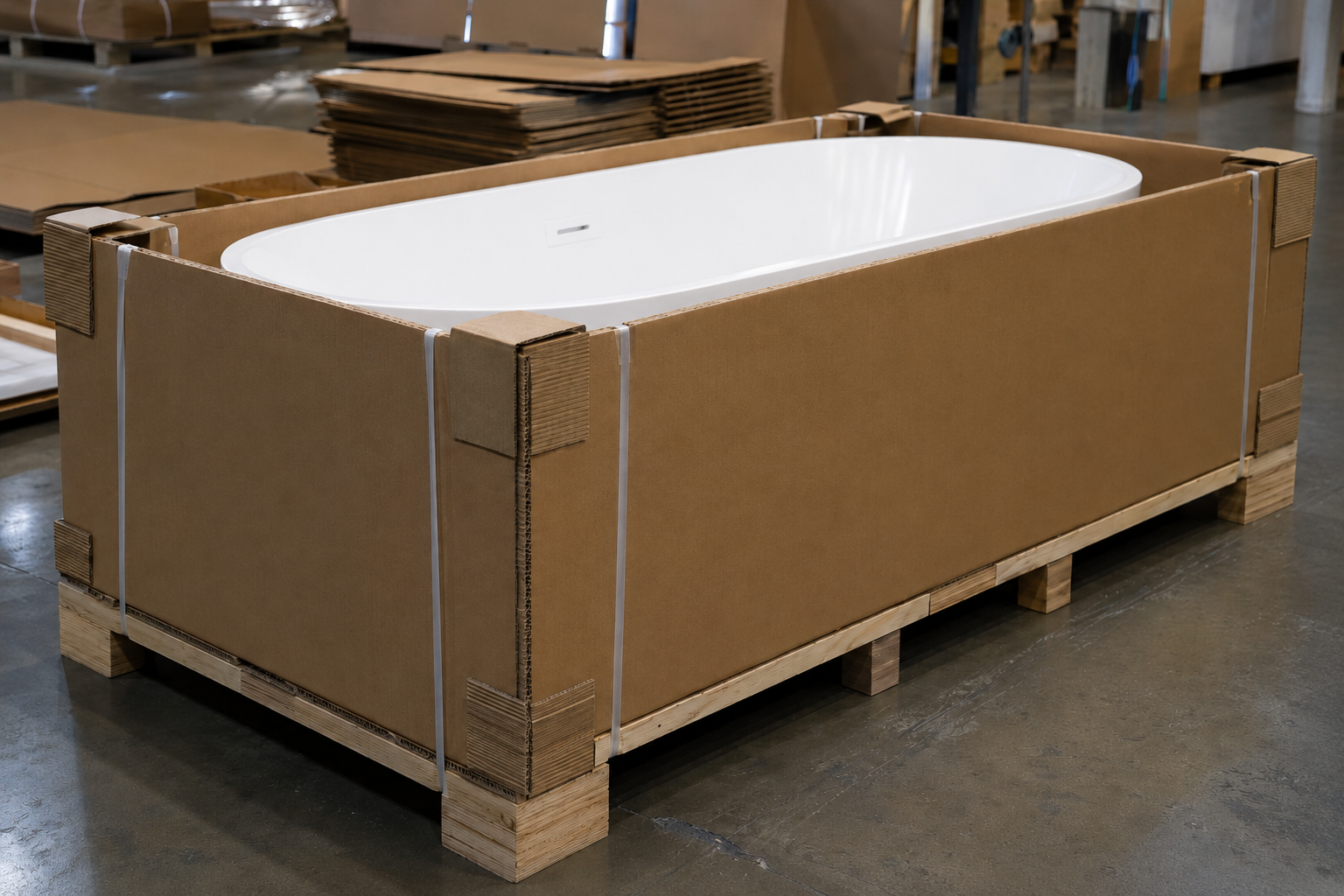
Acrylic bathtubs have large visible surfaces and exposed rims that can be damaged during warehouse handling, container loading, ocean transportation, and unloading.
What Can Happen With Weak Packaging?
- Surface scratches
- Damaged rims
- Cracked corners
- Deformed cartons
- Product movement
- Customer claims
- Replacement shipments
A cheaper packaging solution may save a few dollars at the factory but create a much larger cost after delivery.
What Buyers Should Check
Ask the supplier:
- What carton structure is used?
- How are the edges protected?
- Is there bottom reinforcement?
- Are corners reinforced?
- Are the cartons strapped?
- Can the product be stacked safely?
- Has the packaging been used for export shipments?
At Salvere, packaging is evaluated together with product structure and international transportation requirements rather than treated only as a final carton.
You can read more in our guide on how to reduce bathtub damage during international shipping.
Compare Container Loading, Not Just Product Price
This is one of the most important costs for bathtub importers.
Bathtubs are relatively large products, which means freight cost is heavily affected by volume.
Imagine two suppliers:
| Supplier | Unit Price | Units per Container |
|---|---|---|
| Supplier A | Lower | Fewer |
| Supplier B | Slightly higher | More |
Supplier A may still create a higher landed cost because each bathtub carries a larger share of the container freight.
Why Does Loading Quantity Differ?
It can be affected by:
- Bathtub shape
- Outer-shell structure
- Stackability
- Carton dimensions
- Protective material
- Nesting depth
- Product assembly method
For high-volume programs, even a small improvement in units per container can materially affect logistics efficiency.
What Buyers Should Check
Instead of asking only:
“What is your price?”
Also ask:
“How many units of this model can fit into a 40HQ container?”
And request:
- Carton dimensions
- Packing method
- Loading quantity
- Stacking arrangement
- Actual loading photos if available
For products designed for better logistics efficiency, see our article on why stackable bathtub design matters for importers.
Check Mold and Customization Costs Before Development Starts
For private-label and OEM bathtub projects, the initial product quotation may not include all development expenses.
Additional costs may involve:
- New molds
- Mold modifications
- Custom outer shells
- Special dimensions
- Matte finishes
- Custom colors
- Drain-position changes
- Logo development
- Custom cartons
- Labels
- Product manuals
Why Do Unexpected Costs Appear?
At the early quotation stage, the requested customization may not yet be fully defined.
For example, a buyer may ask for a “custom bathtub,” but that could mean:
- Using an existing mold with a custom logo
- Changing the surface finish
- Developing a different outer shell
- Changing the main thermoformed shape
These are very different projects.
What Buyers Should Check
Before approving the quotation, clarify:
- Is an existing or new mold required?
- Who pays for the mold?
- Who owns the mold?
- Are mold modifications included?
- Which custom features are included in the unit price?
- Are sample fees refundable?
- Does packaging customization create an additional cost?
If you are deciding between tooling strategies, see Existing Mold or Custom Mold: Which Is Better for Your Bathtub Project?.
Certification and Testing Can Affect the Final Cost
A bathtub may need different certifications depending on where it will be sold.
The cheapest quotation may not include the testing or certification required for your market.
This becomes particularly important when:
- A new model is developed
- Production moves to another factory
- Product dimensions change
- Components change
- Drain or overflow systems change
What Buyers Should Check
Before placing an order, confirm:
- Which certification applies to your market?
- Is the quoted model already covered?
- Is the factory included in the relevant certification?
- Does customization require additional testing?
- Who pays for testing or certification?
- Is the cost included in the quotation?
Certification should be discussed before the project reaches mass production—not after the product has already been developed.
Quality Inconsistency Creates Costs That Do Not Appear on the Quotation
This is where the cheapest quotation can become very expensive.
Imagine that a lower-priced supplier creates:
- More surface defects
- Inconsistent dimensions
- Drain-position problems
- Weak reinforcement
- Packaging damage
- Higher customer complaint rates
The factory price may still look attractive.
But the buyer may later pay for:
- Reinspection
- Replacement products
- Additional freight
- Warehouse handling
- Customer credits
- Project delays
- After-sales labor
What Buyers Should Check
Do not evaluate only the approved sample.
Ask how the supplier controls mass production:
- Are first production units inspected?
- Are dimensions measured during production?
- Are materials controlled by batch?
- Are finished products compared with the approved sample?
- Are defects recorded?
- Can problems be traced back to production lots?
A supplier’s real value is demonstrated by how consistently it reproduces the approved product across the complete order.
Lead Time Is Also Part of Cost
A bathtub that is cheaper but regularly late can create another kind of cost.
Late production may cause:
- Inventory shortages
- Missed retail launch dates
- Project delays
- Emergency freight
- Customer dissatisfaction
Why Do Lead-Time Differences Happen?
Possible causes include:
- Material shortages
- Mold availability
- Factory capacity
- Packaging delays
- Custom component delays
- Inspection problems
- Poor production scheduling
What Buyers Should Check
Ask suppliers:
- What is the actual production lead time?
- Does it begin after deposit or after sample approval?
- Are materials already available?
- Is production capacity reserved?
- Is packaging included in the quoted lead time?
- How are delays communicated?
For large programs, the cheapest supplier is not necessarily the best supplier if delivery reliability is weak.
Bathtub Quotation Checklist for B2B Buyers
Before choosing between suppliers, compare the following:
| Area | Questions to Confirm |
|---|---|
| Product | Are dimensions, materials, and structures identical? |
| Components | What drain, overflow, frame, and accessories are included? |
| Packaging | What carton and protection structure is included? |
| Loading | How many units fit in one container? |
| Tooling | Are mold and modification costs included? |
| Customization | Which OEM options create extra cost? |
| Certification | Is the product ready for the target market? |
| MOQ | Is MOQ per model, size, color, or order? |
| Lead time | What is the realistic production schedule? |
| Quality | What inspection standards are used? |
| Claims | How are defects and replacements handled? |
| Payment | What are the deposit and balance-payment terms? |
A quotation becomes much easier to compare when all suppliers answer the same questions.
How Salvere Approaches Acrylic Bathtub Quotations
At Salvere, we believe a B2B quotation should help the buyer understand the complete project—not only the unit price.
For OEM, private-label, and wholesale bathtub programs, quotation discussions can include:
- Product specification
- Existing or custom mold requirements
- Surface finish
- Drain and overflow configuration
- Packaging structure
- Loading quantity
- Custom branding
- Production requirements
- Sample development
Our OEM/ODM acrylic bathtub solutions allow buyers to discuss product development and manufacturing requirements before the project enters mass production.
This helps reduce situations where important costs appear only after the buyer has already selected the supplier.
Conclusion
Comparing acrylic bathtub quotations should not begin and end with unit price.
For B2B buyers, the better comparison is:
Product Specification + Packaging + Container Efficiency + Development Cost + Quality + Delivery + After-Sales Risk
A lower quotation can still become the more expensive option if the product loads poorly, arrives damaged, requires frequent replacement, or causes delays.
The goal is not to choose the supplier with the lowest number on the quotation.
It is to understand which supplier creates the best total value across the complete sourcing process.
Salvere supports bathroom brands, importers, wholesalers, and distributors with acrylic bathtub manufacturing, OEM/ODM development, export packaging, and supply from Vietnam.
Contact Salvere to discuss your acrylic bathtub sourcing project.
FAQ
Why are acrylic bathtub quotations from different factories so different?
Factories may use different acrylic materials, reinforcement structures, components, packaging, production standards, and included services. Buyers should compare specifications before comparing price.
Should buyers always choose the lowest bathtub quotation?
No. A lower factory price may result in higher logistics, damage, inspection, replacement, or after-sales costs.
What should be included in an acrylic bathtub quotation?
The quotation should clearly identify the product model, specification, quantity, unit price, included components, packaging, MOQ, payment terms, production lead time, and applicable customization costs.
Why should container loading quantity be compared?
Bathtubs occupy significant container space. A model that allows more units per container can reduce freight cost per bathtub and improve landed cost.
Are mold costs normally included in the bathtub unit price?
Not always. Custom mold development is commonly treated as a separate project cost. Buyers should confirm mold ownership, modification costs, and whether tooling fees are refundable or separate from production pricing.
How can buyers compare two suppliers more accurately?
Provide both factories with the same technical drawing, material requirements, components, packaging expectations, and order quantity. Then compare unit price, loading efficiency, quality controls, lead time, and total sourcing risk on a like-for-like basis.

