
For bathtub importers, bathroom brands, wholesalers, and project buyers, bathtub dimensions are not only product specifications. They directly affect product selection, installation suitability, packaging design, container loading, warehouse planning, and long-term supply chain efficiency.
Many buyers first look at the visible bathtub size: length, width, and height. But in real B2B sourcing, the more important question is often how that bathtub size works after packaging, stacking, protection, and container loading are considered.
This is especially important for acrylic bathtubs.
Acrylic bathtubs are widely used in modern bathroom markets because they are lighter than many traditional materials, easier to customize, and suitable for large-scale production. However, different bathtub dimensions, rim structures, depths, and shapes can create very different results in shipping and container loading.
For importers, the right bathtub dimension is not only about comfort or bathroom layout. It is also about whether the product can be produced, packed, shipped, stored, and delivered efficiently at scale.
Quick Answer
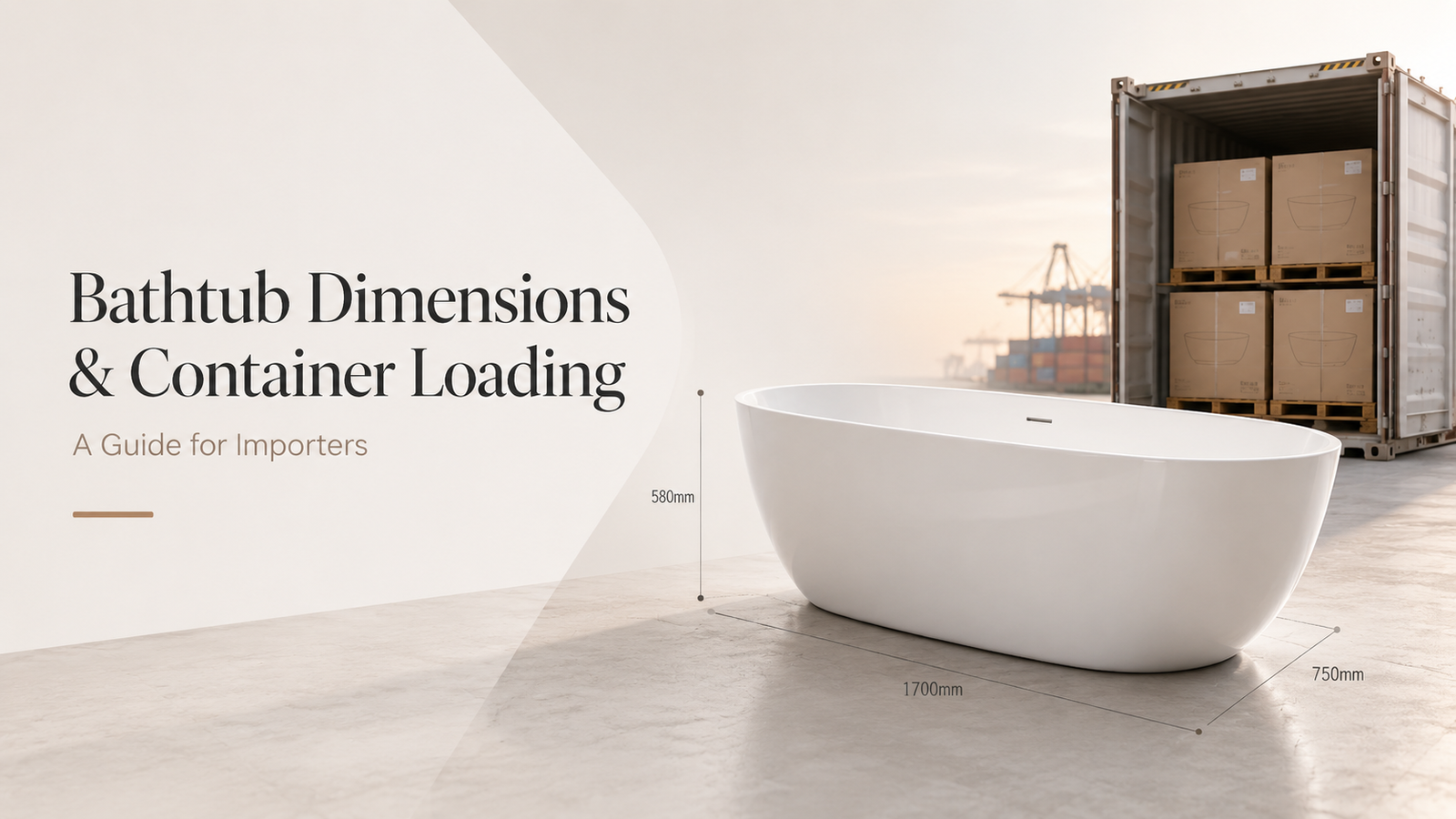
Bathtub dimensions affect container loading because the bathtub’s length, width, height, depth, shape, rim structure, and packaging method all influence how many units can fit safely into one container.
For B2B buyers, the most important point is not only the bathtub size itself, but the final packed dimension. Importers should review product dimensions, packaging dimensions, stacking possibility, protection method, and loading plan before confirming bulk orders.
As a Vietnam-based OEM/ODM acrylic bathtub manufacturer, Salvere helps bathroom brands and importers consider product design, bathtub dimensions, packaging, and container loading together during the sourcing process.
What is the size of a standard bathtub?
A standard bathtub size depends on bathtub type, target market, and installation method.
In many markets, a common alcove bathtub size is around 60 inches in length. However, freestanding bathtubs, soaking tubs, corner tubs, and compact tubs often follow different dimension ranges. For example, freestanding acrylic bathtubs are often developed in different lengths to fit various bathroom layouts, from compact residential spaces to larger premium bathrooms.
For B2B buyers, standard bathtub dimensions should be treated as a market reference, not a fixed rule.
A bathroom brand may need one size range for apartment projects, another for retail showrooms, and another for premium freestanding bathtub collections. Importers also need to consider how each size affects packaging and container loading.
This is why a bathtub dimension sheet should not only include product length, width, and height. It should also include packed dimensions, weight, packaging method, and estimated container loading information.
For professional sourcing, the question is not only:
What is the standard bathtub size?
The better question is:
Is this bathtub size suitable for my target market, my logistics plan, and my product collection?
Are all bathtubs 60 inches?
No, not all bathtubs are 60 inches.
The 60-inch size is common in some markets, especially for standard alcove bathtubs, but it should not be understood as the only bathtub standard. Different bathtub categories have different size logic.
Freestanding bathtubs may be shorter, longer, wider, or deeper depending on their shape and design purpose. A compact freestanding bathtub may be designed for small bathrooms or apartment projects. A larger freestanding bathtub may be developed for villas, premium residential spaces, or hotel suites. Soaking tubs may focus more on depth, while alcove tubs often need to fit fixed wall-to-wall installation spaces.
For B2B buyers, this matters because size selection affects product positioning.
If a brand only follows one standard size, it may miss opportunities in different market segments. A strong bathtub collection usually needs a balanced size strategy, including practical standard models, compact options, and premium larger models.
However, every additional size also affects mold development, inventory planning, packaging, and container loading. This is why brands should choose bathtub sizes carefully instead of adding too many similar dimensions without a clear market reason.
At Salvere, acrylic bathtub development can support different size requirements for OEM/ODM projects, but each dimension needs to be evaluated from both design and export practicality.
How much space is required for a bathtub?
The space required for a bathtub depends on the bathtub type, installation method, surrounding clearance, and bathroom layout.
For consumers, this question is often about whether a bathtub can fit inside a bathroom. For B2B buyers, the question is broader. A bathtub needs to fit not only the bathroom space, but also the project type, installation process, transportation system, and market expectation.
For example, an alcove bathtub usually needs to match a fixed installation area. A freestanding bathtub requires more visual and physical space around it, especially if the design is intended to become a bathroom centerpiece. A soaking tub may require more height or depth, which can affect both user comfort and installation planning.
For hotel, apartment, and residential projects, installation space is closely connected to project efficiency. A bathtub that is difficult to install may create extra work for contractors. A bathtub that requires too much clearance may not be suitable for compact bathrooms. A bathtub with unstable dimensions may create problems during repeated project installation.
For importers and bathroom brands, this means bathtub dimensions should be selected based on real use scenarios.
A product may look attractive in a catalog, but if it does not match the typical bathroom layout of the target market, it may become difficult to sell or difficult to install at scale.
What is a good depth for a bathtub?
A good bathtub depth depends on how the bathtub is intended to be used.
For soaking tubs, deeper dimensions can improve comfort and create a more relaxing bathing experience. For standard residential bathtubs, moderate depth may be more practical for daily use. For hotel or apartment projects, the right depth must balance comfort, safety, installation, and water use.
From a B2B perspective, bathtub depth is not only a user-experience detail. It also affects product structure, packaging height, container loading, and project suitability.
A deeper acrylic bathtub may require stronger support, more careful reinforcement, and a more stable base structure. It may also increase the packed height, which can reduce container loading efficiency if the packaging design is not optimized.
This does not mean deep bathtubs are a problem. In premium bathroom collections, a deeper soaking tub can create a stronger product identity and a better relaxation experience. But for brands and importers, the depth should be considered together with:
- target bathroom size;
- user comfort;
- installation requirements;
- product stability;
- packaging dimensions;
- container loading plan.
A good bathtub depth is not simply the deepest option. It is the depth that fits the product’s market position and can still be manufactured, packed, and shipped reliably.
How do bathtub dimensions affect shipping?
Bathtub dimensions affect shipping because every change in length, width, height, depth, and shape changes how the product occupies space.
In export sourcing, the bathtub’s visible size is only the first layer. The real shipping impact comes from the packed size. Once protective foam, carton structure, wooden frame, pallet, or customized packaging is added, the final shipping dimension may be much larger than the product dimension.
This is especially important for freestanding acrylic bathtubs.
Freestanding tubs often have curved sides, rounded edges, sculptural shapes, or wider upper rims. These details may improve the product’s visual value, but they can also affect stacking and loading. Some bathtub shapes are easier to nest or stack, while others need more individual protection.
For importers, this means bathtub dimension review should always include packaging review.
A bathtub that looks efficient based on its product size may become less efficient after packaging. On the other hand, a well-designed acrylic bathtub with smart packaging can support better container use without compromising product protection.
Packaging also needs to protect different risk areas, including:
- bathtub rim;
- corners and edges;
- surface finish;
- drain and overflow area;
- bottom support;
- outer shell.
For glossy acrylic bathtubs, surface scratches can affect customer perception. For matte acrylic bathtubs, surface marks may be more visible if handling is not controlled. For thin-edge bathtub designs, edge protection becomes even more important.
This is why a professional bathtub manufacturer should consider dimensions, packaging, and shipping together instead of treating them as separate steps.
How many bathtubs fit in a container?
There is no single fixed answer because container loading depends on bathtub type, product dimensions, packed dimensions, stacking method, and packaging structure.
Two bathtubs may have similar lengths, but their loading efficiency can be completely different. A rectangular alcove bathtub may load differently from a freestanding oval bathtub. A compact soaking tub may load differently from a large thin-edge freestanding bathtub. A stackable bathtub may allow better loading efficiency, while a sculptural bathtub may need more space for protection.
For importers, the most important thing is not to ask only for a simple loading quantity.
A reliable supplier should be able to explain how the loading number is calculated based on:
- product dimensions;
- packed dimensions;
- container type;
- stacking method;
- packaging material;
- protection requirements;
- loading safety.
The goal is not to force as many bathtubs as possible into one container. The goal is to load the right quantity safely and consistently.
If the loading plan is too aggressive, products may arrive with surface damage, carton deformation, rim pressure, or other transport-related issues. If the loading plan is too conservative, container space may be underused.
For B2B buyers, the best loading plan should balance protection, efficiency, and repeatability.
At Salvere, container loading is considered part of the export planning process for acrylic bathtub orders. For bathroom brands and importers, this helps make bulk sourcing more predictable and reduces unnecessary problems before shipment.
Can bathtub dimensions be optimized for OEM/ODM projects?
Yes, bathtub dimensions can often be optimized during OEM/ODM development, but this should happen early in the design process.
For custom acrylic bathtub projects, brands may want specific dimensions, deeper soaking space, thinner edges, wider rims, or a more distinctive silhouette. These details influence the visual identity of the product, but they also affect mold development, production stability, packaging, and container loading.
This is why OEM/ODM bathtub dimensions should be reviewed from both design and supply chain perspectives.
For example, a small adjustment in height may improve packaging stability. A more balanced rim design may make the bathtub easier to protect. A slightly more practical length may help the product fit more bathroom layouts. A shape with better nesting potential may improve loading efficiency.
The goal is not to reduce design value. The goal is to create a bathtub that is beautiful, manufacturable, packable, shippable, and suitable for repeat orders.
As a Vietnam-based OEM/ODM acrylic bathtub manufacturer relocated from China, Salvere supports brands with acrylic bathtub customization, including shape, size, surface finish, overflow and drain position, packaging method, and production planning.
For bathroom brands developing new collections, considering dimensions and container loading early can help avoid problems later in bulk production.
Conclusion
Bathtub dimensions are more than basic product measurements.
For importers, bathroom brands, wholesalers, and project buyers, dimensions affect product positioning, installation suitability, packaging design, container loading, storage, and long-term sourcing efficiency.
A bathtub that looks attractive in a catalog still needs to work in real export conditions. Its size, depth, shape, rim design, surface finish, packaging structure, and loading method all influence how smoothly it can move from factory to market.
For acrylic bathtubs, this connection is especially important because the material offers strong design flexibility, but different designs can create very different shipping and loading requirements.
For B2B buyers, the best approach is to evaluate bathtub dimensions together with packaging and container loading before confirming bulk orders or developing new OEM/ODM models.
As a Vietnam-based OEM/ODM acrylic bathtub manufacturer, Salvere helps global bathroom brands consider design, dimensions, packaging, and export practicality together, supporting more stable and efficient acrylic bathtub sourcing from Vietnam.
FAQ
What is the size of a standard bathtub?
A standard bathtub size depends on the bathtub type and market. In some markets, 60 inches is common for alcove bathtubs, while freestanding and soaking bathtubs may have different length, width, and depth ranges.
Are all bathtubs 60 inches?
No. While 60 inches is a common size for some standard bathtubs, freestanding bathtubs, soaking tubs, compact tubs, and premium models may use different dimensions based on design and market needs.
How do bathtub dimensions affect container loading?
Bathtub dimensions affect container loading because length, width, height, depth, shape, and packed size determine how much space each unit occupies inside a container.
Why are packaging dimensions important for bathtub importers?
Packaging dimensions are important because the packed size determines container space, shipping protection, warehouse planning, and delivery handling. For export orders, packed dimensions are often more important than product dimensions alone.
Can acrylic bathtub dimensions be customized?
Yes. Acrylic bathtub dimensions can be customized for OEM/ODM projects, but the size should be evaluated together with mold development, product structure, packaging, and container loading.


