
Ever gotten into a bathtub that just doesn't feel right? Too cramped or too spread out, leaving you feeling unsupported? This discomfort can ruin your relaxing soak, turning a luxury into a chore. As an acrylic bathtub manufacturer, I understand that width is key to true comfort.
Bathtub width directly impacts user comfort by determining the available space for the body, especially for shoulders, hips, and legs. An ideal width allows for natural posture, adequate support, and freedom of movement without feeling either cramped or unstable. Too narrow, and users feel squeezed; too wide, and they may struggle for support, affecting overall relaxation.
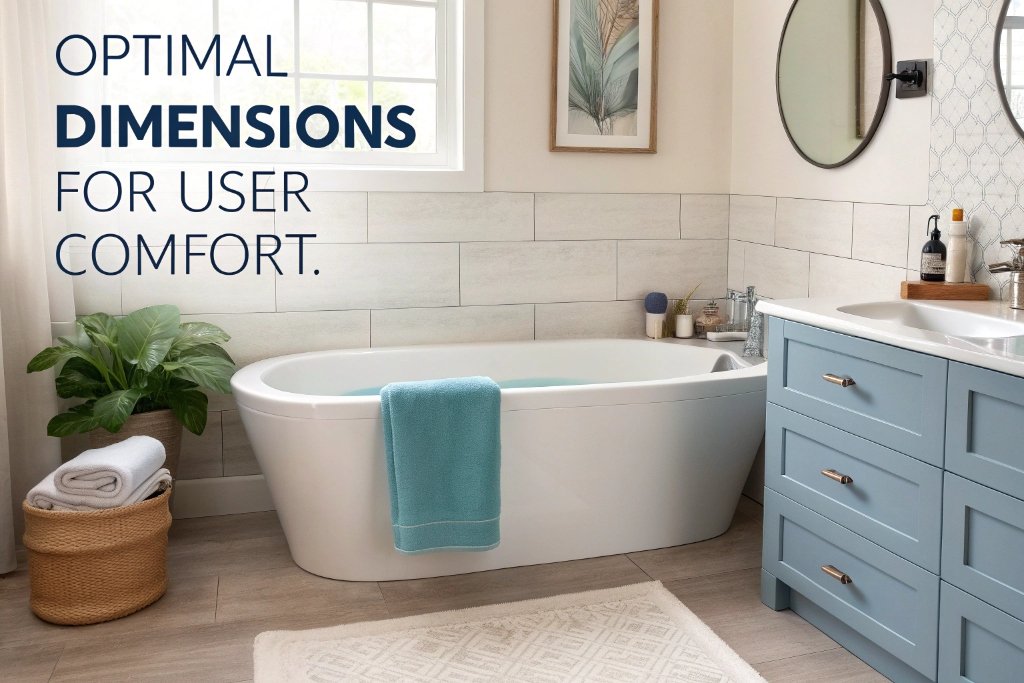
Choosing the right bathtub width is crucial. It directly influences how much you enjoy your daily soak. Let's explore how different widths affect the bathing experience and what truly makes a bathtub comfortable.
The Relationship Between Bathtub Width and Body Ergonomics?
Does your bathtub leave you feeling awkward or unsupported? Improper width can lead to uncomfortable positions. I know that true relaxation comes from ergonomic design.
Bathtub width directly relates to body ergonomics by providing adequate space and support for the user's frame, primarily across the shoulders, hips, and along the legs. An ergonomically sound width allows the body to be comfortably nestled and supported, promoting natural posture and reducing strain, ensuring an unhindered and relaxed bathing experience tailored to various body types.
Ergonomics in a bathtub is about designing the space to support the human body in a natural, comfortable posture, reducing stress on joints and muscles. The width of a tub is a primary factor in achieving this. For example, if a bathtub is too narrow, a user's shoulders might be forced inward, leading to a hunched posture and tension in the neck and upper back. Their hips might feel squeezed, restricting natural movement and causing discomfort. Legs might have to be bent uncomfortably or feel constantly pressed against the tub's sides, preventing full relaxation. Conversely, a bathtub that is excessively wide can also be problematic. A smaller individual might feel "lost" in a very wide tub, struggling to brace themselves against the sides. This can lead to subconscious muscle tension as they try to maintain stability, negating the purpose of a relaxing bath. They might slide around, unable to find a comfortable resting position. An ideal width allows for the user's natural shoulder width to be accommodated with a slight gap, providing gentle support from the side walls. It gives enough room for the hips to rest without feeling confined and permits comfortable leg extension or bending. When designing acrylic tubs at Salvere, we consider internal dimensions carefully, incorporating subtle curves and sloped backrests that work with varying body shapes. We understand that the internal bathing width, rather than just the external rim width, is what truly defines ergonomic comfort. My experience confirms that a well-designed width ensures the user is cradled and supported, not squeezed or floating.
Narrow vs. Wide Bathtubs: Comfort Trade-Offs in Real Use?
You might think a bigger tub is always better, but is it? Sometimes a bathtub can be too wide. Let's look at the real comfort trade-offs.
Narrow bathtubs offer a more compact, supported feel for smaller individuals but can be confining for larger users. Wide bathtubs provide spaciousness and freedom of movement but may leave smaller individuals feeling unsupported or unstable. The comfort trade-off lies in balancing personal body dimensions with the desire for either snug support or expansive room, influencing how relaxed and stable a user feels during their soak.
The choice between a narrow and a wide bathtub involves significant comfort trade-offs that impact the actual bathing experience. When considering narrow bathtubs, typically with an internal width of less than 28 inches, they can offer a cozy, almost cradling sensation for smaller or average-sized individuals. This snugness can feel secure and help conserve water, which is a practical benefit. However, for larger individuals, a narrow tub quickly becomes a confined space. It restricts movement, forcing limbs to be cramped or awkwardly positioned against the sides. This creates a feeling of restriction rather than relaxation, potentially leading to discomfort or even minor abrasions if the user constantly brushes against the tub walls. On the other hand, wide bathtubs, often exceeding 32 inches in internal width, provide a luxurious sense of spaciousness and freedom of movement. These are ideal for larger users who need ample room, or for those who enjoy bathing with children or even a pet. This expansive space allows for comfortable stretching and turning. The trade-off for smaller users is that they might feel "lost" in such a large tub. Without the side walls to brace against, they may unconsciously tense their muscles to maintain stability, which defeats the purpose of a relaxing bath. This lack of support can make them slide around, preventing a truly comfortable rest. As a manufacturer, I find that different activities also affect the perception of width. For example, someone wanting to read in the tub might prefer a slightly narrower width to brace an arm, while someone wanting a full, uninhibited soak might prefer wider. There is no universally "best" width. My experience at Salvere shows that the ideal choice always depends on the primary user's body size and their specific bathing preferences.
How Bathtub Width Affects Shoulder, Arm, and Leg Support?
Ever tried to relax in a tub but your arms keep slipping, or your legs feel unsupported? Bathtub width plays a huge role in this. I know precise dimensions matter.
Bathtub width significantly affects shoulder, arm, and leg support by dictating the interior space available for proper body alignment. An appropriate width ensures shoulders can rest comfortably against the sides, arms can relax without hanging uncomfortably, and legs have enough room to extend or bend without feeling confined or unsupported. This provides stability, prevents muscle strain, and enhances overall comfort during a bath.
The width of a bathtub directly dictates how well various parts of the body are supported, profoundly impacting the user's comfort and ability to relax. Let's break this down:
- Shoulder Support:
- Too Narrow: If the internal width is too tight, a user's shoulders are pushed forward or constantly pressed against the sides. This creates tension in the neck, upper back, and shoulders, preventing the muscles from relaxing. It can lead to a hunched posture, which is the opposite of a comfortable soak.
- Too Wide: Conversely, a tub that is too wide might offer no support for the shoulders at all. The user's body floats freely, making it difficult to lean back comfortably against the sloped backrest without bracing themselves, which leads to muscle fatigue.
- Ideal: The perfect width allows the shoulders to rest gently against the side walls, providing a subtle brace that helps maintain an upright yet relaxed posture. This enables the chest to open up, promoting deeper breathing and full relaxation.
- Arm Support:
- Too Narrow: Arms might be awkwardly squeezed between the body and the tub's sides, or forced to hang uncomfortably over the rim.
- Too Wide: Arms tend to float aimlessly in the water, making it difficult to find a stable resting position or to reach the tub's edge for support.
- Ideal: With the right width, arms can comfortably rest along the body or be propped up on integrated armrests or the tub's rim without strain. At Salvere, we sometimes integrate subtle armrests into the acrylic molding to enhance this comfort.
- Leg Support:
- Too Narrow: Legs might be uncomfortably bent, with knees hitting the sides, or they might feel cramped, restricting movement.
- Too Wide: Legs can float freely, leading to a feeling of instability. It becomes hard to brace oneself, especially when trying to adjust position or get out of the tub.
- Ideal: A good width allows legs to extend comfortably without being restricted, or to bend with feet flat against the tub's base, providing a sense of grounding and stability. The internal base width is especially critical for leg and hip comfort.
The subtle curves and precise molding capabilities of acrylic allow us to engineer these support zones effectively. My experience has shown that a well-designed acrylic tub, with carefully considered width, cradles the body from shoulders to legs, transforming a simple bath into a truly supportive and restorative experience.
Bathtub Width Considerations for Different User Groups?
Who is using the bathtub in your home? A family, an elderly person, or just you? The ideal width changes dramatically depending on the user. I consider everyone.
Bathtub width considerations vary significantly across user groups. Children need shallower, slightly narrower tubs for safety and easier supervision. Elderly or mobility-impaired individuals benefit from wider, more accessible tubs for easier entry, exit, and maneuverability, often with grab bar access. Average adults seek a balanced width for comfortable soaking, while larger individuals require wider tubs to avoid feeling cramped. Understanding these diverse needs ensures optimal comfort and safety for every user.
The "perfect" bathtub width is not universal; it heavily depends on who will be primarily using it. As an OEM/ODM manufacturer, I recognize the importance of designing for diverse user groups to ensure comfort and safety for everyone.
- Children and Families:
- For children, depth is often a primary safety concern, but width plays a role too. A slightly narrower tub might make it easier for a parent to sit alongside and assist with bathing, or to reach across to help a child. A very wide, deep tub could be overwhelming or even unsafe for small children.
- Elderly or Mobility-Impaired Individuals:
- For this group, accessibility is paramount. Wider tubs are essential for easier entry and exit, often in conjunction with grab bars or integrated seats. A narrow tub can pose a significant fall hazard and make transferring in and out of the tub extremely difficult. Walk-in tubs are designed specifically for this, often featuring very wide entry points.
- Average Adults:
- Most standard bathtubs (around 30-32 inches external width, yielding about 24-28 inches internal bathing width) are designed for this demographic. The goal is a balance: enough room to feel comfortable and move slightly, but not so wide that one feels unsupported or has to strain to reach the sides. My experience shows that this "sweet spot" ensures optimal relaxation for the majority of users.
- Larger Individuals:
- For those with broader shoulders or larger frames, a standard tub can feel very restrictive. Wider bathtubs (often 34 inches or more external width) are crucial to prevent shoulders from being bunched and to allow hips and legs enough space. Without sufficient width, discomfort is guaranteed.
- Couples or Shared Baths:
- If a bathtub is intended for two people to comfortably bathe simultaneously, it must be significantly wider, often 40-42 inches or more, and typically features dual backrests and central drain placement.
At Salvere, we offer a range of standard widths and also provide OEM/ODM services to customize widths. This ensures that whether for a single residential client or a large housing project targeting specific demographics, we can provide bathtubs that perfectly match the comfort and safety needs of the intended users.
Space Planning: Balancing Bathroom Size and Bathtub Width?
Is your bathroom tiny, but you dream of a luxurious bath? Or is your large space feeling empty? Finding the right bathtub width to fit your bathroom is a challenge. I see this often.
Space planning involves balancing the desired bathtub width with available bathroom dimensions to ensure both comfort and functional clearance. A wider tub enhances comfort but demands more floor space, impacting walkways and fixture placement. Conversely, a narrower tub conserves space but may compromise user comfort. Strategic layout, considering internal vs. external width, is key to achieving an aesthetically pleasing and highly functional bathroom without overcrowding or underutilizing the area.
Successfully integrating a bathtub into a bathroom is not just about its length; width plays a critical role in how the entire space functions and feels. Balancing the desire for a comfortable bathing experience with the practical constraints of bathroom dimensions is a common challenge I see.
Width Considerations by Bathroom Size:
- Small Bathrooms (e.g., 5'x8'):
- Challenge: Maximizing bathing comfort within a very limited footprint while maintaining essential clearances.
- Solution: These bathrooms typically require alcove bathtubs. The focus shifts to maximizing the internal bathing width while keeping the external footprint as minimal as possible. Tubs with narrower rims or integrated apron fronts are often chosen. You might not get a sprawling, wide tub, but a well-designed one can still feel surprisingly comfortable internally. For example, a standard 60-inch long tub might vary in internal width by several inches based on rim design.
- Medium Bathrooms (e.g., 8'x10'):
- Opportunity: More flexibility for slightly wider tubs, or even a smaller freestanding model.
- Need: Balance enhanced bathing comfort with maintaining clear walkways and appropriate spacing between fixtures (toilet, vanity, shower). Over-sizing the tub here can make the room feel cramped.
- Large Bathrooms (e.g., 10'x12'+):
- Opportunity: Ideal for wide, luxurious freestanding bathtubs or spacious drop-in models.
- Need: Ensure the tub's width is substantial enough to feel proportionate to the room, preventing it from looking "lost" in a vast space. Clearances are less of an issue, but visual balance is important.
Key Distinction: Internal vs. External Width
It is crucial to differentiate between a bathtub's external width (rim-to-rim) and its internal bathing width (the usable space at the bottom or shoulder level). A tub with a wide external width might have very wide rims, reducing the actual comfortable space inside. Always prioritize the internal bathing width for comfort.
Clearance Requirements
| Regardless of bathroom size, designers must adhere to local building codes regarding clearances. For instance, typically 21-24 inches of clear space is needed in front of a tub for safe access. A tub that is too wide for the space can compromise these critical clearances. My experience at Salvere, working with project developers and residential clients, confirms that thoughtful space planning ensures the chosen bathtub width contributes to both the bathroom's aesthetic appeal and its practical functionality. |
Bathroom Size | Bathtub Type | Width Considerations |
|---|---|---|---|
| Small (e.g., 5'x8') | Alcove/Compact Drop-in | Maximize internal width, minimize rim thickness | |
| Medium (e.g., 8'x10') | Alcove, Smaller Freestanding | Balance comfort with walkway clearances | |
| Large (e.g., 10'x12'+) | Freestanding, Wider Drop-in | Ample internal width, consider visual balance with room |
Customizing Bathtub Width for Comfort in Residential and Project Use?
Standard tubs don't always fit unique needs or designs. Are you stuck with off-the-shelf sizes? I believe comfort should never be compromised.
Customizing bathtub width ensures optimal comfort for specific residential preferences or large-scale project requirements that standard sizes cannot meet. This bespoke approach allows for precise ergonomic tailoring to individual body types, specific bathroom dimensions, or unique design aesthetics. OEM/ODM manufacturers can adjust internal and external widths, backrest angles, and seat placements, guaranteeing a perfect fit that maximizes user comfort and functional efficiency, whether for a single homeowner or hundreds of units in a housing development.
In many cases, an off-the-shelf bathtub simply doesn't provide the optimal comfort or fit for a unique space or user. This is where the power of customization, particularly with a flexible material like acrylic, truly shines. As an OEM/ODM manufacturer like Salvere, I am uniquely positioned to address these needs, ensuring comfort is never compromised.
Residential Customization:
- Individual Preferences: A homeowner might be exceptionally tall and need an extra few inches of legroom, or have broader shoulders requiring a wider internal bathing area than standard models provide. Customization can involve slightly adjusting the internal width or the backrest angle to perfectly cradle their body.
- Unique Bathroom Layouts: Some bathrooms have unusual alcove dimensions or architectural features that standard tubs simply won't fit perfectly. Customizing the external width allows the tub to seamlessly integrate into these spaces, maximizing both space efficiency and comfort.
- Aging-in-Place Considerations: For homeowners planning for future accessibility, a slightly wider tub might make entry and exit easier, even without becoming a full walk-in unit. Customizing width can provide that extra degree of maneuverability.
- I have worked with clients who have struggled to find a tub that felt "just right." With acrylic, we can often make minor, yet impactful, adjustments to internal dimensions that transform a merely functional tub into a truly comfortable sanctuary.
Project Use (Developers/Hotels):
- Brand Consistency and Design Language: Large housing developers or hotel chains often need a consistent aesthetic and comfort level across hundreds or thousands of units. However, different room types or floor plans might require slight variations in tub width. An OEM/ODM partner can create custom molds to produce a family of tubs with consistent design but tailored widths.
- Target Demographic Needs: A developer building luxury condominiums might target an older, more affluent demographic who prioritize spaciousness and ease of use, requiring wider, more generously proportioned tubs. Conversely, a project aimed at young professionals might prioritize space-saving, but still comfortable, options. Customization ensures the tubs align with the specific needs of the target buyer.
- Optimized Production Efficiency: While standard sizes offer economies of scale, for large-volume orders, investing in custom molds for a specific width can actually become more cost-effective. It ensures every unit perfectly meets the project's specifications, reducing waste and installation issues.
- Our factory in Vietnam is built precisely for this flexibility. We don't just produce standard tubs; we partner with clients to develop custom solutions. The thermoforming process of acrylic allows for efficient mold creation and iteration, making these width adjustments feasible and scalable for large-scale production without the prohibitive costs associated with other materials.
Customization in bathtub width ensures that every user, whether an individual homeowner or a resident in a large housing development, experiences optimal comfort tailored precisely to their needs and space.
Conclusion
Bathtub width is paramount for comfort. It dictates body support, relaxation, and overall user experience. Choosing the right width, whether standard or customized, significantly enhances bathing enjoyment and bathroom functionality.
👉 Learn more about Salvere Acrylic Bathtub Products
and how we manufacture acrylic bathtubs in Vietnam.

