
Peak season can put pressure on every part of a bathtub supply chain.
Factories receive more orders, production schedules become tighter, raw materials need to be secured earlier, shipping space becomes harder to arrange, and small delays can quickly affect inventory and customer delivery.
For U.S. importers, distributors, and bathroom brands, the biggest risk is not simply that lead times become longer.
The real problem is that several supply-chain pressures can happen at the same time.
A production delay of one week may become a much larger problem if container booking is also delayed and inventory is already running low.
The best way to manage peak season is not to react faster. It is to prepare earlier and create more flexibility before capacity becomes tight.
Quick Answer
To reduce bathtub supply chain risk during peak season, buyers should:
- Confirm production capacity earlier
- Place orders before the factory schedule becomes full
- Prioritize high-volume and fast-moving SKUs
- Keep reasonable inventory buffers
- Secure packaging and materials in advance
- Plan container loading and shipping earlier
- Maintain an alternative supplier for critical products
For buyers with a high level of sourcing concentration, qualifying a second OEM/ODM acrylic bathtub supplier before peak season can also provide additional capacity and flexibility.
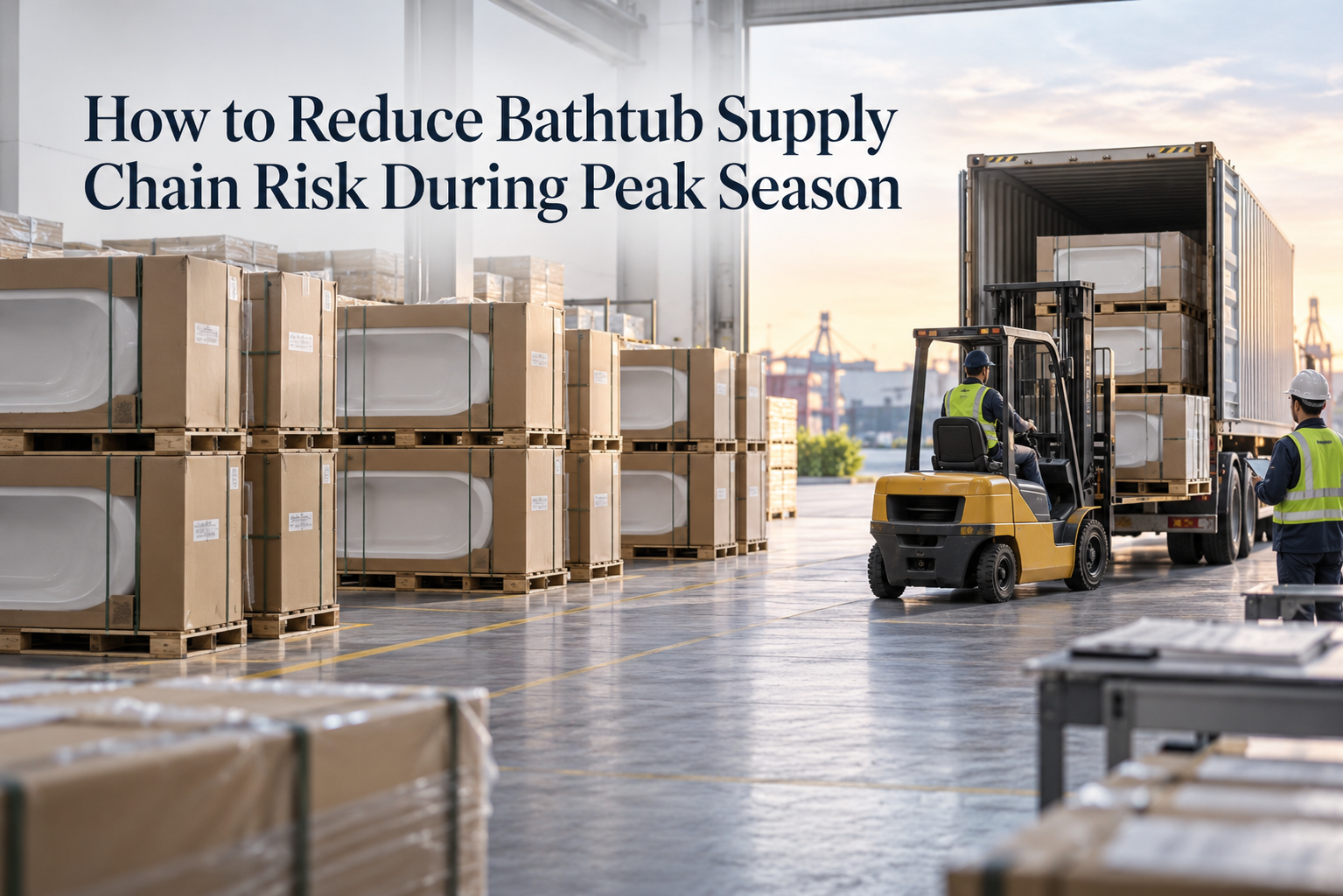
Why Peak Season Creates More Supply Chain Risk
During normal periods, a small delay may be easy to absorb.
During peak season, the same delay can affect several steps at once.
| Risk Area | Peak Season Pressure | Possible Result |
|---|---|---|
| Factory capacity | More orders compete for production | Longer lead time |
| Raw materials | Higher demand | Material delays |
| Labor | Production workload increases | Lower efficiency |
| Quality control | Faster production pace | Higher defect risk |
| Packaging | More orders require cartons and materials | Packing delays |
| Shipping | Limited vessel and container space | Delayed departure |
| Inventory | Faster sales and slower replenishment | Stockout risk |
The objective is therefore not only to protect production.
Buyers need to protect the entire flow from purchase order to warehouse arrival.
Confirm Factory Capacity Before the Schedule Becomes Full
One of the most common peak-season problems is placing an order based on the normal lead time.
A supplier may normally require 30 or 40 days, but that does not mean the same schedule will still be available when several large orders arrive at once.
Buyers should discuss peak-season capacity before issuing urgent purchase orders.
The important question is not only:
“What is your monthly capacity?”
It is:
“How much production capacity is actually available for our orders during this period?”
A factory may have strong theoretical capacity but already have a large part of its production schedule committed to other customers.
For important bathtub programs, buyers should confirm production windows early and avoid assuming that capacity will remain available.
Prioritize the SKUs That Matter Most
Not every bathtub model requires the same level of protection.
During peak season, the most important products are usually high-volume, fast-moving, or difficult-to-replenish SKUs.
If a company has 30 bathtub models, it may not be necessary to increase inventory or reserve extra capacity for all 30.
Instead, purchasing teams can identify the models that create the greatest business impact if they go out of stock.
For example, a best-selling freestanding bathtub may need an earlier purchase order and more safety stock, while a low-volume design can remain on the normal ordering cycle.
This allows buyers to use production capacity and working capital more efficiently.
Place Orders Earlier — but Do Not Simply Overorder
Ordering earlier is one of the simplest ways to reduce peak-season risk.
However, earlier ordering should not mean buying excessive inventory.
Too much stock creates its own problems, including warehouse cost, cash-flow pressure, and slower inventory turnover.
A better approach is to combine forecast data with the full replenishment cycle.
That means considering:
Factory Lead Time + Packaging + Container Booking + Ocean Freight + Customs + Warehouse Receiving
If the complete replenishment cycle becomes longer during peak season, the reorder point should also move earlier.
The goal is to create enough buffer to absorb delays without turning every SKU into excess inventory.
Secure Materials and Packaging Before Production Starts
Peak-season risk is not limited to the bathtub production line.
Raw materials, cartons, foam, wooden boards, components, labels, and other packaging materials also need to be available at the right time.
A factory may have production capacity but still face delays if packaging or supporting materials arrive late.
For acrylic bathtubs, this is especially important because packaging directly affects international shipping protection.
Buyers should confirm that key materials are prepared according to the production schedule rather than waiting until the final stage.
This reduces the chance that finished bathtubs are waiting in the factory simply because packaging materials are not ready.
Do Not Let Faster Production Reduce Quality Control
One of the biggest risks during peak season is that production speed increases while inspection standards remain unchanged—or become less consistent.
This can lead to problems such as surface defects, dimensional variation, reinforcement issues, incorrect drain positions, or packaging mistakes.
The buyer should not assume that a factory producing faster will automatically maintain the same quality level.
Key inspections should still be completed at the required stages, especially for:
- Surface condition
- Critical dimensions
- Drain and overflow positions
- Reinforcement
- Structural stability
- Packaging
For larger orders, buyers may also increase sampling frequency or request additional pre-shipment inspection.
You can read more in our guide on What Should Be Checked Before Shipping an Acrylic Bathtub Order?.
Plan Container Loading and Shipping Earlier
Production can be completed on time and still arrive late.
During peak shipping periods, container availability, vessel schedules, and port congestion can become additional bottlenecks.
Bathtubs are large-volume products, so loading efficiency is especially important.
A small difference in packaging dimensions or model mix can affect how many units fit into a container.
Buyers should therefore coordinate production and logistics together instead of treating shipping as the final step.
If possible, container booking should begin before the entire order is finished.
The purchasing team should also understand which SKUs can be mixed efficiently and which products require different loading arrangements.
This improves both delivery reliability and freight efficiency.
Build an Alternative Supply Option Before Peak Season
If the main supplier becomes fully booked during peak season, finding another factory at the last minute is rarely easy.
A new supplier may need time for sample approval, specification review, packaging tests, and pilot production.
That is why backup capacity should be developed before the supply chain becomes stressed.
For buyers that currently depend heavily on one manufacturing country, working with a qualified bathtub factory outside of China can also provide another production option.
This does not mean moving all bathtub SKUs.
A practical approach is to test a few representative models with a second OEM/ODM acrylic bathtub supplier.
If the new source performs well, it can support:
- Additional peak-season volume
- Selected high-demand SKUs
- New product development
- Emergency replenishment
- Future sourcing diversification
For a broader supply-chain strategy, see How to Build a Resilient Bathtub Supply Chain for U.S. Importers.
Improve Communication During the Production Cycle
Peak season makes early communication more important.
A small issue becomes more difficult to solve if the buyer learns about it only a few days before shipment.
Suppliers should provide clear updates on:
- Material readiness
- Production progress
- Quality issues
- Packaging status
- Expected completion date
- Shipping preparation
The purpose is not to request daily updates on every order.
It is to identify risks early enough for the purchasing team to adjust inventory, logistics, or customer commitments.
A reliable supplier should communicate potential delays before they become missed deadlines.
Peak Season Supply Chain Checklist
| Area | What Buyers Should Confirm |
|---|---|
| Capacity | Is enough production capacity reserved? |
| SKUs | Which models need priority? |
| Forecast | Are purchase orders placed early enough? |
| Materials | Are acrylic, components, and packaging ready? |
| Quality | Will inspection standards remain consistent? |
| Packaging | Is export packaging prepared in time? |
| Shipping | Is container space booked early? |
| Inventory | Is there enough buffer for key SKUs? |
| Backup source | Can another supplier support additional volume? |
| Communication | Are production risks reported early? |
How Salvere Can Support Peak Season Supply Planning
For bathroom brands and importers that need additional acrylic bathtub capacity, Salvere can provide a specialized manufacturing source in Vietnam.
Buyers do not need to move their entire bathtub program.
A more practical approach is to begin with several selected SKUs and use Salvere as an additional source for high-volume products, new models, or peak-season demand.
Because Salvere focuses on OEM/ODM acrylic bathtub manufacturing, our production experience covers thermoforming, CNC processing, fiberglass reinforcement, structural support, surface finishing, quality control, packaging, and container loading.
This specialization allows buyers to work with a factory that understands the production requirements of acrylic bathtubs rather than treating them as one product category among many.
For companies looking for a bathtub factory outside of China, Salvere can also provide another manufacturing origin in Vietnam. This can help reduce dependence on a single sourcing region while creating additional capacity before peak demand begins.
Buyers can start with existing molds to reduce initial development time or work with Salvere on custom molds and OEM/ODM projects for new product programs.
The main value during peak season is flexibility.
If Salvere has already produced and approved several of the buyer's SKUs, additional volume can be allocated much more quickly than starting a new supplier search after the primary factory is already fully booked.
Learn more about Salvere’s OEM/ODM Acrylic Bathtub Solutions.
Conclusion
Peak-season supply-chain problems rarely come from one issue alone.
Production capacity, materials, packaging, shipping, inventory, and quality can all become more difficult to manage at the same time.
The best protection is preparation.
Buyers should identify critical SKUs, reserve capacity earlier, maintain realistic inventory buffers, protect quality standards, plan logistics in advance, and build alternative supply options before they are urgently needed.
Peak season should not be the time to build a backup plan. It should be the time when the backup plan is already ready.
FAQ
When should bathtub importers prepare for peak season?
Planning should begin before supplier capacity and shipping space become tight. The exact timing depends on production lead time, ocean freight, inventory levels, and seasonal demand.
Should buyers increase inventory before peak season?
For critical and fast-moving SKUs, additional buffer stock can be useful. However, inventory should be based on forecast and replenishment time rather than simply increasing every model.
How can buyers avoid quality problems when factories are busy?
Maintain the same inspection standards, monitor critical production stages, and consider additional pre-shipment checks for large or important orders.
Should importers use a second bathtub supplier during peak season?
A qualified second supplier can provide additional capacity and reduce dependence on one factory, but the supplier should be tested before peak season begins.
Why consider a Vietnam bathtub supplier for peak-season planning?
Vietnam can provide an additional manufacturing origin for buyers that want more capacity or geographic diversification. The key is selecting a factory with the right acrylic bathtub specialization, quality control, production capability, and export experience.


