
For many bathroom brands and importers, China has been an important sourcing base for years. The manufacturing ecosystem is mature, product categories are broad, and buyers are familiar with the supplier network.
But relying too heavily on one country also creates concentration risk.
Tariffs, freight changes, capacity shortages, policy uncertainty, or regional disruption can affect a large part of the supply chain at the same time.
This is why more buyers are considering a China + 1 sourcing strategy.
The idea is not to replace China completely. It is to keep the advantages of the existing China supply base while adding another qualified manufacturing country for selected products.
For bathtub buyers, Vietnam can be a practical option—especially for companies looking for an experienced OEM/ODM acrylic bathtub supplier or a reliable bathtub factory outside of China.
China + 1 is not about leaving China. It is about avoiding having only one sourcing option.
Quick Answer
A China + 1 strategy can help bathtub importers:
- Reduce dependence on one sourcing country
- Prepare for tariff and landed-cost changes
- Build alternative production capacity
- Test a second source before it becomes urgent
- Work with more specialized suppliers by product category
Vietnam may be a suitable second source when buyers can find a factory with the right product specialization, production capability, quality control, and export experience.
For acrylic bathtub programs, working with a specialized OEM/ODM acrylic bathtub manufacturer in Vietnam can provide both geographic diversification and stronger category expertise.
The key is not to move everything at once.
A better approach is to keep what already works in China and gradually develop a qualified bathtub factory outside of China for selected SKUs.
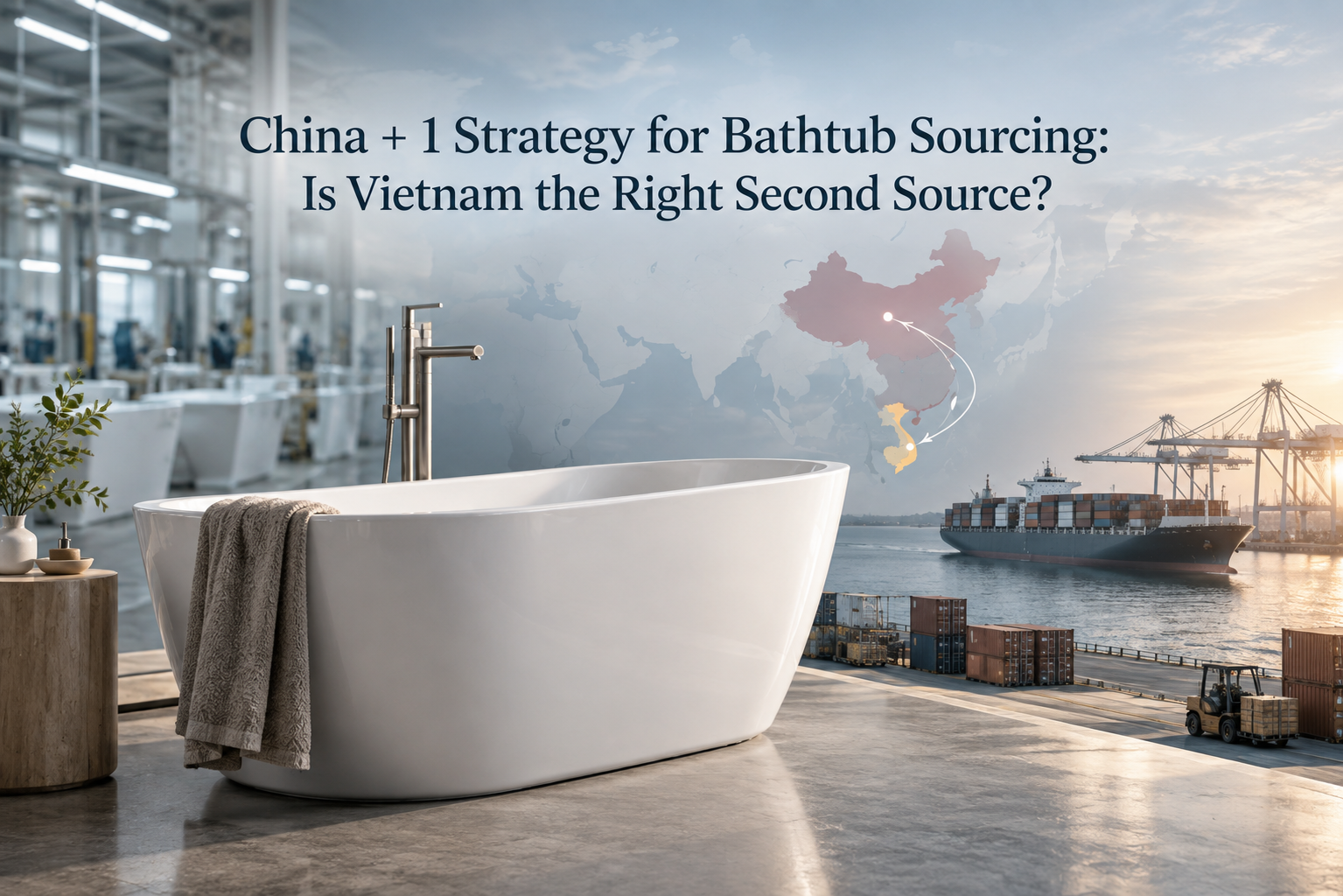
What Does China + 1 Mean for Bathtub Sourcing?
China + 1 usually means maintaining existing production in China while developing an additional manufacturing source in another country.
For a bathroom-products company, this does not require moving the complete product portfolio.
A buyer may continue sourcing vanities, mirrors, faucets, or other categories from existing suppliers while adding an OEM/ODM acrylic bathtub source in Vietnam.
This creates a more balanced supply structure.
| Supply Strategy | Main Advantage | Main Limitation |
|---|---|---|
| China only | Convenient and highly consolidated | Higher geographic concentration |
| Full relocation | Reduces dependence on China | Higher transition risk |
| China + 1 | Keeps existing strengths while adding flexibility | Requires additional supplier management |
For many importers, China + 1 is more practical than a full relocation because it adds flexibility without unnecessarily disrupting an existing supply chain.
Keep the Advantages of the Existing China Supply Base
China remains attractive to many bathroom-product buyers because of its broad manufacturing ecosystem.
Multiple product categories can often be sourced within the same region, making supplier visits, inspections, consolidation, and logistics easier.
If current suppliers are performing well, there may be no reason to replace them.
The purpose of China + 1 should therefore not be:
“Move everything away from China.”
A better question is:
“Which product categories or SKUs would benefit from an additional source?”
For bathtub importers, this may mean keeping the existing China supply base while developing a qualified bathtub factory outside of China for part of the acrylic bathtub program.
This approach keeps the convenience of the current supply chain while reducing excessive dependence on one country.
Use Vietnam to Reduce Geographic Concentration
Working with several suppliers does not always mean the supply chain is truly diversified.
If all suppliers are located in the same country, they may still face the same tariff changes, regional logistics issues, or capacity pressure.
Adding Vietnam creates another manufacturing origin.
For buyers with significant acrylic bathtub volume, a Vietnam-based supplier can become an additional source for selected SKUs, new product development, or future capacity.
This gives the purchasing team more flexibility if sourcing conditions change.
The important point is that the second source should already be tested.
A bathtub factory outside of China becomes valuable only when the buyer has already approved samples, verified production quality, and understands the supplier’s real capability.
Start With a Few SKUs — Not the Whole Collection
A China + 1 strategy does not require a full product-line transfer.
In fact, moving every SKU too quickly can create unnecessary tooling, certification, inventory, and quality risks.
A more practical approach is to begin with a few representative products.
For example, the buyer may test:
- One high-volume freestanding bathtub
- One standard alcove bathtub
- One stable repeat-order model
These products can be used to evaluate the new supplier under real order conditions.
The buyer can compare quality consistency, lead time, packaging, communication, and container loading before deciding whether to increase volume.
If the first orders perform well, more SKUs can be introduced gradually.
A second source should prove that it works before it becomes a major part of the supply chain.
This is especially useful when testing a new OEM/ODM acrylic bathtub supplier in another country.
China + 1 Can Improve Supplier Specialization
Geographic diversification is only one reason to develop another source.
Another benefit is specialization.
When buyers source many bathroom categories from one region, convenience can become the main priority.
But a supplier offering many product categories may not have the same depth of expertise in each one.
Acrylic bathtub manufacturing requires specific knowledge in areas such as:
- Thermoforming
- Acrylic stretching control
- CNC processing
- Fiberglass reinforcement
- Structural support
- Surface finishing
- Drain-position control
- Export packaging
This is where a specialized OEM/ODM acrylic bathtub factory can provide additional value.
Instead of asking one supplier to manage many unrelated bathroom products, the buyer can work with factories that focus deeply on each category.
For acrylic bathtubs, this can improve product development, quality control, production consistency, and technical communication.
Compare Total Supply-Chain Value, Not Only Unit Price
Adding a Vietnam supplier should not be based only on factory price.
Buyers should compare the total supply-chain value:
Factory Price + Tariff + Freight + Packaging + Container Efficiency + Inventory + Quality Risk + Lead Time
A supplier in Vietnam may not always offer the lowest initial unit price.
But the overall value can still be attractive if the factory provides:
- A different manufacturing origin
- Additional capacity
- Stronger bathtub specialization
- More sourcing flexibility
- Better preparation for future tariff changes
This is why China + 1 should be viewed as a supply-chain strategy rather than a simple quotation comparison.
The purpose is to create more options before a disruption forces the buyer to make a rushed decision.
Make Sure Vietnam Is a Real Second Source
Adding a Vietnam supplier to a supplier list is not enough.
The factory should be able to take real production volume when needed.
Buyers should verify:
| Area | What Buyers Should Check |
|---|---|
| Product capability | Can the factory produce the required bathtub structures? |
| Quality | Can mass production match the approved sample? |
| OEM/ODM | Can the factory support custom dimensions, molds, finishes, and packaging? |
| Mold | Are existing or custom mold options available? |
| Capacity | Can the supplier absorb additional volume? |
| Packaging | Is export packaging suitable for international shipping? |
| Lead time | Can production support the buyer’s replenishment plan? |
| Communication | Can problems be identified and communicated early? |
A real second source should already understand the buyer's product requirements and be able to increase production when the sourcing strategy changes.
That is the difference between simply finding a bathtub factory outside of China and building a usable China + 1 supply source.
Is Vietnam the Right Second Source for Every Bathtub Importer?
Not necessarily.
Vietnam makes more sense when the buyer has enough volume to justify an additional sourcing base and can find manufacturers with the required specialization.
Buyers should still consider:
- Product complexity
- Mold investment
- Certification
- Lead time
- Logistics
- Internal supplier-management capability
For some companies, single-country sourcing may remain efficient.
But for importers with significant volume, long-term U.S. market exposure, or high dependence on one manufacturing region, Vietnam can provide useful supply-chain flexibility.
The key is not simply choosing Vietnam.
It is choosing the right OEM/ODM acrylic bathtub supplier in Vietnam.
How Salvere Can Support a China + 1 Bathtub Sourcing Strategy
For bathroom brands and importers that already have an established China supply base, Salvere can provide an additional OEM/ODM acrylic bathtub manufacturing source in Vietnam.
The starting point does not need to be a full product transfer.
Buyers can begin with several selected SKUs and evaluate Salvere through real production orders. This allows the purchasing team to compare product quality, batch consistency, lead time, packaging, container loading, and communication before committing larger volume.
For buyers that want to test a bathtub factory outside of China without making a large initial tooling investment, Salvere’s existing bathtub molds can provide a practical starting point. Once the Vietnam source has been validated, additional models, custom molds, or exclusive designs can be introduced gradually.
Salvere focuses specifically on acrylic bathtub manufacturing, including freestanding, alcove, corner, skirted, and other acrylic bathtub structures.
Our OEM/ODM acrylic bathtub capabilities include product development, custom molds, dimensions, drain positions, surface finishes, reinforcement, packaging, and private-label requirements.
This specialization is important for buyers that want China + 1 to achieve more than geographic diversification.
The goal may also be to build a more professional category-specific supplier base.
For that reason, Salvere does not need to replace the buyer’s existing China suppliers.
Instead, Salvere can become the “+1” acrylic bathtub source—supporting selected SKUs, additional production capacity, new product development, or future volume shifts when tariffs or sourcing conditions change.
For buyers actively searching for a qualified bathtub factory outside of China, Salvere can provide a practical way to test Vietnam with controlled risk and gradually build a second supply source.
Learn more about Salvere's OEM/ODM Acrylic Bathtub Solutions.
Conclusion
A China + 1 strategy should not be treated as a complete relocation from China.
For bathtub importers, the more practical approach is to keep the parts of the existing supply chain that already work while gradually building another qualified manufacturing source.
Vietnam can provide that additional option, especially for buyers looking for a specialized OEM/ODM acrylic bathtub supplier and a reliable bathtub factory outside of China.
Start with a few SKUs, evaluate real production performance, and increase volume only when the new source has proven itself.
The goal of China + 1 is not to replace one dependency with another. It is to create more sourcing options before you need them.
FAQ
Does China + 1 mean moving bathtub production out of China?
No. China + 1 usually means keeping existing China production while adding another manufacturing country to reduce concentration and improve supply-chain flexibility.
Why can Vietnam be considered for acrylic bathtub sourcing?
Vietnam can provide an additional manufacturing origin for buyers seeking a bathtub factory outside of China. The key is finding a factory with the right specialization, quality control, production capability, and export experience.
Should all bathtub SKUs be moved to Vietnam?
No. Buyers can start with a few representative or high-volume SKUs, evaluate the new supplier through real orders, and gradually increase the product range.
What should buyers look for in an OEM/ODM acrylic bathtub supplier?
Important areas include product-development capability, mold options, quality consistency, production capacity, packaging, lead time, and communication.
Can China + 1 help manage tariff risk?
It can improve flexibility by giving buyers another qualified manufacturing origin. Buyers should still compare current landed cost, tariff conditions, logistics, and transition costs before shifting volume.


