
When sourcing acrylic bathtubs, a low factory price can be very attractive.
For importers, wholesalers, and bathroom brands, saving a few dollars per unit can appear to create a strong competitive advantage.
However, the initial purchase price is only one part of the total sourcing cost.
A bathtub with a lower quotation may create additional expenses later through quality issues, shipping damage, production delays, replacement orders, or customer complaints.
For B2B buyers, the better question is not:
“Which supplier offers the lowest bathtub price?”
It is:
“Which supplier provides the best overall value after considering quality, logistics, reliability, and long-term costs?”
Based on Salvere’s experience working with international bathroom brands and distributors, this guide explains the hidden costs behind cheap acrylic bathtubs and what buyers should evaluate before making a sourcing decision.
For a detailed comparison method, you can also read our guide on How to Compare Acrylic Bathtub Quotations Beyond Unit Price.
Quick Answer
A cheap acrylic bathtub quotation may create hidden costs through:
- Lower material quality
- Weak structural reinforcement
- Higher shipping damage risk
- Poor production consistency
- Additional customization charges
- Longer lead times
- Higher replacement and after-sales costs
Before choosing a supplier, buyers should compare more than unit price.
A reliable evaluation should include:
- Product specification
- Material quality
- Manufacturing process
- Packaging protection
- Container efficiency
- Quality control system
- Production capacity
- Long-term supplier reliability
The lowest quotation is not always the lowest-cost solution.
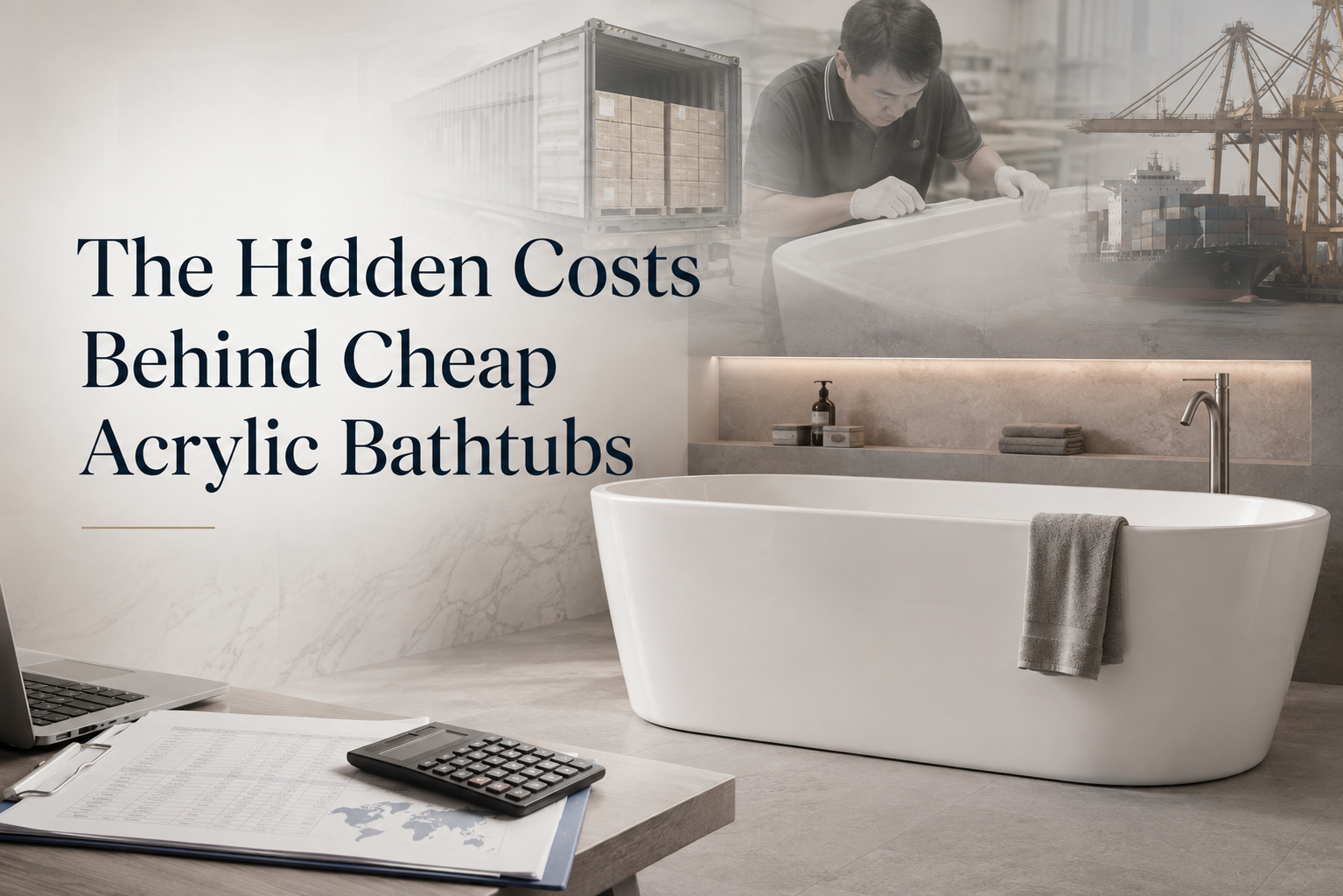
Why a Lower Bathtub Price Can Become a Higher Business Cost
A bathtub supplier’s quotation usually represents the manufacturing cost of the product.
However, the buyer’s real cost continues after production.
The complete cost may include:
A supplier with a slightly higher unit price may actually provide a lower total cost if the products arrive consistently, require fewer replacements, and support smoother operations.
Hidden Costs Behind Cheap Acrylic Bathtubs
| Hidden Cost | Why It Happens | What Buyers Should Check |
|---|---|---|
| Material problems | Lower-cost acrylic or inconsistent materials | Acrylic specification, thickness, material source |
| Structural issues | Reduced reinforcement or weaker construction | Fiberglass reinforcement, bottom support, production standards |
| Shipping damage | Weak packaging and poor protection | Carton strength, foam protection, stacking method |
| Quality inconsistency | Weak production control | Batch inspection process and quality standards |
| Unexpected customization costs | Important requirements excluded from quotation | Mold, finish, packaging, branding costs |
| Delivery delays | Limited capacity or poor planning | Production schedule and factory capacity |
| After-sales costs | More complaints and replacements | Defect handling process and supplier responsibility |
Lower Material Quality Can Create Long-Term Problems
The acrylic sheet is one of the most important components of an acrylic bathtub.
However, two bathtubs may look almost identical while using different material standards.
A lower quotation may result from:
- Lower-grade acrylic sheets
- Reduced material thickness
- Different reinforcement materials
- Less strict material inspection
- Inconsistent material batches
Why Does This Happen?
Material is one of the easiest areas for manufacturers to reduce cost.
A supplier may lower the product price by reducing material specifications while keeping a similar appearance when the bathtub is new.
However, these differences may become visible over time through:
- Surface performance
- Color stability
- Structural strength
- Customer complaints
- Product lifespan
What Buyers Should Check
Before comparing prices, buyers should confirm:
- What type of acrylic sheet is used?
- What is the sheet thickness?
- Is the material specification consistent between batches?
- Are incoming materials inspected?
- Does the factory have stable material suppliers?
A lower material cost at the beginning may create higher product risk after the bathtub reaches the market.
Weak Reinforcement Can Create Structural Problems
The acrylic surface creates the visible appearance of the bathtub, but reinforcement determines much of its structural stability.
A bathtub requires proper support to maintain:
- Shape stability
- Weight-bearing performance
- Long-term durability
- Installation reliability
Why Does This Happen?
Some low-cost suppliers reduce production costs by:
- Using less fiberglass reinforcement
- Reducing reinforcement layers
- Simplifying bottom support
- Shortening production time
These decisions may reduce manufacturing cost but increase the risk of:
- Flexing
- Cracking
- Uneven support
- Customer complaints after installation
What Buyers Should Check
Ask suppliers:
- How is the bathtub reinforced?
- What materials are used?
- Is reinforcement consistent across batches?
- Is the bottom structure strong enough?
- Are production standards documented?
A bathtub should not only look good in a product photo.
It should maintain performance after installation.
You can also learn more about production consistency in our article:
How to Evaluate Batch Consistency in Acrylic Bathtub Production.
Cheap Packaging Can Increase Shipping Costs
Packaging is often one of the first areas where suppliers try to reduce costs.
However, international bathtub shipping involves:
- Ocean transportation
- Container loading
- Warehouse handling
- Multiple transfers
- Long-distance delivery
Weak packaging can create costs far beyond the original savings.
Why Does This Happen?
Cost-focused packaging may include:
- Thinner cartons
- Less edge protection
- Limited corner reinforcement
- Poor stacking support
- Insufficient internal protection
Possible results:
- Scratches
- Damaged rims
- Cracked corners
- Customer rejection
- Replacement shipments
What Buyers Should Check
Before approving a supplier, ask:
- What carton structure is used?
- How are visible surfaces protected?
- Are bathtub edges reinforced?
- Can products be safely stacked?
- How are cartons secured?
For international shipments, packaging is part of product quality—not an optional extra.
You can learn more about export protection in:
How to Reduce Bathtub Damage During International Shipping.
Low Initial Prices May Hide Development Costs
For OEM and private-label projects, the first quotation may not include every development cost.
A bathtub project may require additional investment in:
- Custom molds
- Mold modifications
- New dimensions
- Special finishes
- Custom packaging
- Labels
- Product manuals
- Sample adjustments
Why Does This Happen?
At the beginning of a project, buyers may describe their requirements generally:
“I need a unique bathtub.”
However, uniqueness can mean very different things:
- A different color
- A different finish
- A modified shape
- A completely new mold
Each option creates different development costs.
What Buyers Should Check
Before confirming a supplier, clarify:
- Is the mold included?
- Who owns the mold?
- Are modifications included?
- Are samples charged separately?
- Is custom packaging included?
- Are branding requirements included?
A clear development agreement prevents unexpected costs later.
For more information:
Existing Mold or Custom Mold: Which Is Better for Your Bathtub Project?
Inconsistent Production Creates Hidden After-Sales Costs
A sample can look perfect.
But the real challenge is whether the supplier can reproduce the same quality across hundreds or thousands of units.
Why Does This Happen?
Production inconsistency may come from:
- Weak quality control systems
- Different production operators
- Uncontrolled material variation
- Lack of inspection standards
- Poor communication between sample and mass production
The hidden costs may include:
- Replacement units
- Customer complaints
- Additional inspection
- Warehouse sorting
- Brand reputation damage
What Buyers Should Check
Ask suppliers:
- How are first production units inspected?
- Are products checked during production?
- Are dimensions measured?
- Are finished products compared with approved samples?
- Are defects recorded and analyzed?
A professional supplier should not only produce samples well.
They should be able to repeat the same quality consistently.
Longer Lead Time Can Increase Supply Chain Costs
A low-priced bathtub is not useful if it arrives too late.
Delivery delays can create:
- Retail stock shortages
- Project delays
- Missed launch dates
- Emergency freight costs
- Customer dissatisfaction
Why Does This Happen?
Possible causes include:
- Factory capacity limitations
- Material shortages
- Poor production planning
- Packaging delays
- Slow problem-solving
What Buyers Should Check
Before placing large orders, ask:
- What is the realistic production lead time?
- Is production capacity available?
- Are materials prepared in advance?
- How are delays communicated?
- What happens if production is delayed?
A reliable supplier should provide predictable delivery, not only attractive pricing.
Hidden Cost Checklist for Acrylic Bathtub Buyers
| Evaluation Area | Questions Buyers Should Ask |
|---|---|
| Material | What acrylic specification is used? |
| Structure | How is reinforcement controlled? |
| Quality | How is mass production consistency ensured? |
| Packaging | How are products protected during shipping? |
| Loading | How many units fit in a container? |
| Customization | Are mold and branding costs included? |
| Lead Time | Is the production schedule realistic? |
| Certification | Are market requirements covered? |
| After-sales | How are defects and replacements handled? |
Why Experienced Manufacturers Create Better Total Value
Choosing a bathtub supplier is not only a price decision.
Experienced manufacturers understand that buyers need:
- Stable product quality
- Predictable delivery
- Export-ready packaging
- Clear communication
- Consistent production
- Long-term cooperation
At Salvere, we focus on helping global bathroom brands and importers reduce sourcing risk through:
- OEM/ODM acrylic bathtub development
- Quality-controlled production processes
- Export packaging solutions
- Production planning
- Custom product support
Our goal is not to offer the lowest possible quotation.
It is to help customers build a reliable bathtub supply chain with predictable quality and cost.
Learn more about our:
OEM/ODM Acrylic Bathtub Solutions
Conclusion
A cheap acrylic bathtub may look attractive at the quotation stage.
But the real cost appears after the purchase order is placed.
Material issues, weak packaging, inconsistent production, hidden customization fees, and delivery problems can quickly eliminate the initial price advantage.
For B2B buyers, the better approach is:
Compare total value, not only unit price.
The right supplier should help reduce risk throughout the entire process:
Product Development → Manufacturing → Quality Control → Packaging → Delivery
A reliable acrylic bathtub partner is not necessarily the cheapest supplier.
It is the supplier that creates the lowest total business risk.
FAQ
Why are some acrylic bathtubs much cheaper than others?
Price differences usually come from differences in materials, reinforcement, production standards, packaging, included components, and quality control systems.
Is a higher bathtub price always better?
Not necessarily. The goal is not to choose the most expensive supplier, but to choose the supplier that provides the best balance between quality, cost, reliability, and service.
What is the biggest hidden cost when buying cheap bathtubs?
For many importers, the biggest hidden costs come from quality problems, shipping damage, replacements, and delayed deliveries.
How can buyers compare bathtub suppliers more accurately?
Use the same product specification and compare not only unit price, but also packaging, loading efficiency, quality systems, lead time, and after-sales support.
Should buyers avoid low-price bathtub suppliers completely?
No. Competitive pricing can be valuable. The key is understanding what is included in the quotation and whether the supplier can consistently deliver the required quality.


